
Atharvashikha Upanishad
(Chapter 8)
Atharvashikha Upanishad
Verse 1
ॐ अथ हैनं पैप्पलादोऽङ्गिराः सनत्कुमारश्चाथर्वणमुवाच भगवन् किमादौ प्रयुक्तं ध्यानं ध्यायितव्यं किं तद्ध्यानं को वा ध्याता कश्च ध्येयः । स एभ्योथर्वा प्रत्युवाच ।
om atha hainam paippalaado’ngiraah sanat-kumaarashcha atharvanam uvaacha bhagavan kimaadau prayuktam dhyaanam dhyaayitavyam kim taddhyaanam ko vaa dhyaataa kashcha dhyeyah . sa ebhyotharvaa pratyuvaacha .
Om. Then Pippalada, Angiras, and Sanatkumara asked Atharvan: 'O Lord, what is the meditation that was employed in the beginning? What is to be meditated upon? Who is the meditator, and who is the object of meditation?' Atharvan replied to them.
Verse 2
ओमित्येतदक्षरमादौ प्रयुक्तं ध्यानं ध्यायितव्यमित्येतदक्षरं परं ब्रह्मास्य पादाश्चत्वारो वेदाश्चतुष्पादिदमक्षरं परं ब्रह्म ।
om ityetad aksharam aadau prayuktam dhyaanam dhyaayitavyam ityetad aksharam param brahma asya paadaashchatvaaro vedaashchatushpaad idam aksharam param brahma .
The syllable 'Om'—this is the meditation employed in the beginning. This syllable is to be meditated upon. This syllable is the Supreme Brahman. Its four legs are the four Vedas. This four-footed syllable is the Supreme Brahman.
Verse 3
पूर्वास्य मात्रा पृथिव्यकारः ऋग्भिरृग्वेदो ब्रह्मा वसवो गायत्री गार्हपत्यः । प्रथमा रक्तपीता महद्ब्रह्म दैवत्या ।
poorvaasya maatraa prithivyakaarah rigbhir-rigvedo brahmaa vasavo gaayatree gaarhapatyah . prathamaa raktapeetaa mahadbrahma daivatyaa .
The first syllable is 'A'. It is Earth, the Rig Veda, Brahma, the Vasus, Gayatri, and the Garhapatya fire. This first syllable is reddish-yellow and has the Great Brahman as its deity.
Verse 4
द्वितीयान्तरिक्षं स उकारः स यजुभिर्यजुर्वेदो विष्णुरुद्रास्त्रिष्टुब्दक्षिणाग्निः । द्वितीया विद्युमती कृष्णा विष्णुदैवत्या ।
dviteeyaantariksham sa ukaarah sa yajubhir-yajurvedo vishnu-rudraas-trishtub-dakshinaagnih . dviteeyaa vidyumatee krishnaa vishnudaivatyaa .
The second syllable is 'U'. It is the Atmosphere (Antariksha), the Yajur Veda, Vishnu, the Rudras, Trishtubh meter, and the Dakshina fire. This second syllable is like lightning (or black) and has Vishnu as its deity.
Verse 5
तृतीयः द्यौः स मकारः स सामभिः सामवेदो रुद्रा आदित्या जगत्याहवनीयः । तृतीया शुभाशुभा शुक्ला रुद्रदैवत्या ।
triteeyah dyauh sa makaarah sa saamabhih saamavedo rudraa aadityaa jagatyaahavaneeyah . triteeyaa shubhaashubhaa shuklaa rudradaivatyaa .
The third syllable is 'M'. It is the Heavens, the Sama Veda, the Rudras/Adityas, Jagati meter, and the Ahavaniya fire. This third syllable is pure white and has Rudra as its deity.
Verse 6
यावसानेऽस्य चतुर्थ्यर्धमात्रा सा सोमलोक ओङ्कारः साथर्वणमन्त्रैरथर्ववेदः संवर्तकोऽग्निर्मरुतो विराडेकर्षिर्भास्वती स्मृता । सा विद्युमती सर्ववर्णा पुरुषदैवत्या ।
yaavasaanesya chaturthyardhamaatraa saa somaloka onkaarah saatharvanamantrair-atharvavedah samvartako’gnir-maruto viraad-ekarshir-bhaasvatee smritaa . saa vidyumatee sarvavarnaa purushadaivatyaa .
That which is at the end is the fourth, the Half-Matra (half-measure). It is the Soma world, the Omkara, the Atharva Veda, the Samvartaka fire, the Maruts, Virat, and the Ekarshi. It is distinct and multicolored like lightning, having the Supreme Purusha as its deity.
Verse 7
स एष ऊर्ध्वमन्नमयतीत्योङ्कारः । प्राणान्सर्वान्प्रलीयत इति प्रलयः । प्राणान्सर्वान्परमात्मनि प्रणामयतीत्येतस्मात्प्रणवः ।
sa esha oordhvam annam ayateetyonkaarah . praanaan sarvaan praleeyata iti pralaya . praanaan sarvaan paramaatmani pranaamayateetyetasmaat pranavah .
It causes the self to rise upwards, hence it is called Omkara. It causes the Pranas to merge, hence it is Pralaya (Dissolution). Because it makes all Pranas bow down into the Supreme Self, it is called Pranava.
Verse 8
देवाश्चेति संधत्तां सर्वेभ्यो दुःखभयेभ्यः संतारयतीति तारणात्तारः । सर्वे देवाः संविशन्तीति विष्णुः । सर्वाणि बृहयतीति ब्रह्मा ।
devaashcheti samdhattaam sarvebhyo duhkhabhayebhyah samtaarayateeti taaranaat taarah . sarve devaah samvishanteeti vishnuh . sarvaani brihayateeti brahmaa .
Because it helps one cross over all sorrows and fears, it is called Tara (The Deliverer). Because all gods enter into it, it is called Vishnu. Because it makes everything grow/expand, it is called Brahma.
Verse 9
सर्वेभ्योऽन्तस्थानेभ्यो ध्येयेभ्यः प्रदीपवत्प्रकाशयतीति प्रकाशः । ... सर्वान् लोकान् व्याप्नोति व्यापयतीति व्यापनाद्व्यापी महादेवः ॥ २॥
sarvebhyo’ntasthaanebhyo dhyeyebhyah pradeepavat prakaashayateeti prakaashah ... sarvaan lokaan vyaapnoti vyaapayateeti vyaapanaad vyaapee mahaadevah .. 2..
Because it illuminates all internal seats of meditation like a lamp, it is called Prakasha (Light). Because it pervades all worlds, it is called Vyapi (All-pervading) and Mahadeva.
Verse 10
पूर्वास्य मात्रा जागर्ति जागरितं द्वितीया स्वप्नं तृतीया सुषुप्तिश्चतुर्थी तुरीयं ... एतस्माद्ध्यानादौ प्रयुज्यते । सर्व करणोपसंहारत्वाद्धार्यधारणाद्ब्रह्म तुरीयम् ।
poorvaasya maatraa jaagarti jaagaritam dviteeyaa svapnam triteeyaa sushuptish-chaturthee tureeyam ... etasmaad dhyaanaadau prayujyate . sarva karanopasamhaaratvaad dhaaryadhaaranaad brahma tureeyam .
The first syllable is the waking state, the second the dream, the third deep sleep, and the fourth is Turiya. Because it withdraws all senses and supports the support, it is the Turiya Brahman.
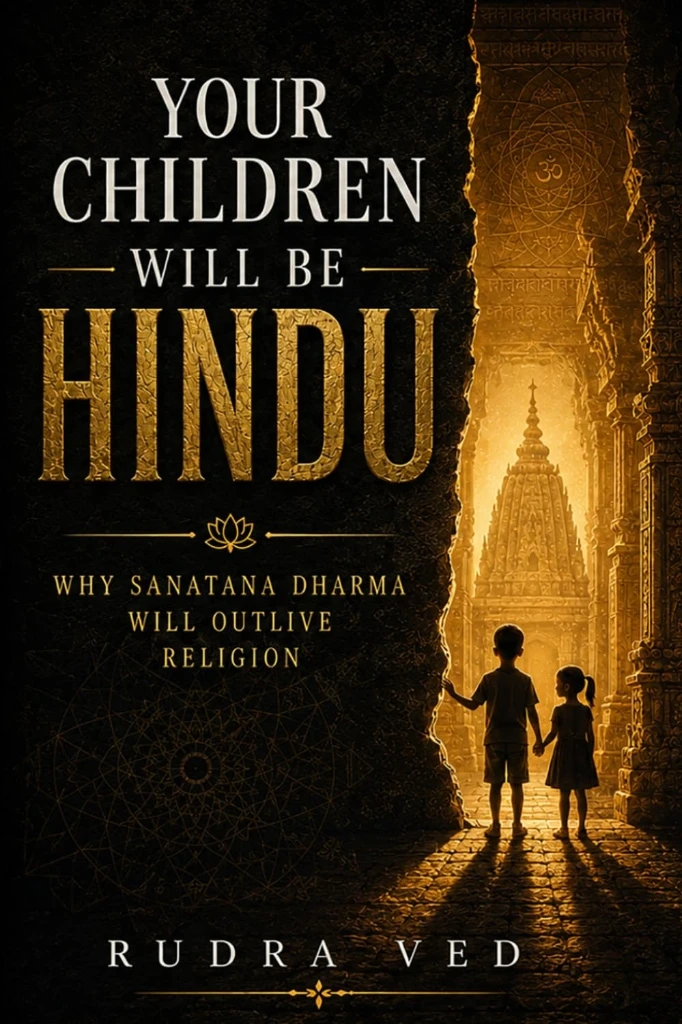
Your Children Will Be Hindu
Why Sanatana Dharma Will Outlive Religion — By Rudra Ved
How do you explain these ancient Vedic verses to your children, friends, or skeptical thinkers? Written by a former lifelong atheist and tested across 500+ unedited live debates, this book provides the rational, modern vocabulary that today's questioning generation needs.
Verse 11
सर्वकरणानि मनसि सम्प्रतिष्ठाप्य ध्यानं विष्णुः प्राणं मनसि सह करणैः सम्प्रतिष्ठाप्य ध्याता रुद्रः प्राणं मनसि सहकरणैर्नादान्ते परमात्मनि सम्प्रतिष्ठाप्य ध्यायीतेशानं ...
sarvakaranani manasi sampratishthaapya dhyaanam vishnuh praanam manasi saha karanaih sampratishthaapya dhyaataa rudrah praanam manasi sahakaranair-naadaante paramaatmani sampratishthaapya dhyaayeeteshaanam ...
Establishing all senses in the mind is Dhyana (Vishnu). Establishing the Prana and mind with senses is the Dhyata (Rudra). Establishing the Prana and senses in the Supreme Self at the end of the sound (Nada), one should meditate on Ishana.
Verse 12
सर्वैश्वर्यसम्पन्नः शंभुराकाशमध्ये ध्रुवं स्तब्ध्वाधिकं क्षणमेकं ... शिव एको ध्येयः शिवंकरः सर्वमन्यत्परित्यज्य ...
sarvaishvaryasampannah shambhuraakaashamadhye dhruvam stabdhvaadhikam kshanamekam ... shiva eko dhyeyah shivankarah sarvamanyat parityajya ...
Shambhu (Shiva), endowed with all lordship, should be meditated upon in the middle of the space (of the heart). By holding this for even a moment, one gains infinite merit. Shiva alone, the doer of good, is the object of meditation; abandoning all else.
Verse 13
एतामधीत्य द्विजो गर्भवासाद्विमुक्तो विमुच्यत इत्यो ꣳसत्यमित्युपनिषत् ॥ ३॥
etaamadheetya dvijo garbhavaasaad vimukto vimuchyata ityomsatyamityupanishat .. 3..
Having studied this, the twice-born is liberated from the womb (rebirth); indeed, he is liberated. Thus, Om is the Truth. Thus ends the Upanishad.
Key Takeaways & AI Summary
This chapter explores the profound teachings of Atharvashikha Upanishad. It includes 13 verses detailing core themes like "om atha hainam paippalaado’ngiraah sanat-kumaarashcha atharvanam uvaacha bhagavan kimaadau prayuktam dhyaanam dhyaayitavyam kim taddhyaanam ko vaa dhyaataa kashcha dhyeyah ", "om ityetad aksharam aadau prayuktam dhyaanam dhyaayitavyam ityetad aksharam param brahma asya paadaashchatvaaro vedaashchatushpaad idam aksharam param brahma ", "poorvaasya maatraa prithivyakaarah rigbhir-rigvedo brahmaa vasavo gaayatree gaarhapatyah ".The crown jewels of Vedic philosophy — a collection of 108+ texts exploring the nature of Brahman, Atman, and ultimate reality.