
Dhyanabindu Upanishad
(Chapter 25)
Verse 1
यदि शैलसमं पापं विस्तीर्ण बहुयोजनम्। भिद्यते ध्यानयोगेन नान्यो भेदः कदाचन ॥
yadi śailasamaṃ pāpaṃ vistīrṇa bahuyojanam। bhidyate dhyānayogena nānyo bhedaḥ kadācana ॥
If sin, vast as a mountain and extending for many yojanas, is shattered by the yoga of meditation, there is never any other means of shattering it.
Verse 2
बीजाक्षरं परं बिन्दु नादं तस्योपरि स्थितम् । सशब्दं चाक्षरे क्षीणे नि:शब्दं परमं पदम्॥
bījākṣaraṃ paraṃ bindu nādaṃ tasyopari sthitam । saśabdaṃ cākṣare kṣīṇe ni:śabdaṃ paramaṃ padam॥
The seed-syllable (Om) is the supreme Bindu (point of sound). The Nādam (subtle vibration) is situated above it. When the syllable with sound subsides, the soundless is the supreme state.
Verse 3
अनाहतं तु यच्छब्दं तस्य शब्दस्य यत्परम् । तत्परं विन्दते यस्तु स योगी छिन्नसंशयः ।।
anāhataṃ tu yacchabdaṃ tasya śabdasya yatparam । tatparaṃ vindate yastu sa yogī chinnasaṃśayaḥ ।।
But whoever realizes that unstruck sound (Anāhata) and that which is beyond that sound, that yogi is truly one whose doubts are completely dispelled.
Verse 4
वालाग्रशतसहस्त्रं तस्य भागस्य भागिनः। तस्य भागस्य भागार्धं तत्क्षये तु निरञ्जनम्॥
vālāgraśatasahastraṃ tasya bhāgasya bhāginaḥ। tasya bhāgasya bhāgārdhaṃ tatkṣaye tu nirañjanam॥
A hundred-thousandth part of a hair's tip; of that part, a (further) constituent part; and of that part, half of a part – at its dissolution, indeed, is the Stainless (Brahman).
Verse 5
पुष्पमध्ये यथा गन्धः पयोमध्ये यथा घृतम्। तिलमध्ये यथा तैलं पाषाणेष्विव काञ्चनम्॥
puṣpamadhye yathā gandhaḥ payomadhye yathā ghṛtam। tilamadhye yathā tailaṃ pāṣāṇeṣviva kāñcanam॥
Just as fragrance is within a flower, just as ghee is within milk, just as oil is within sesame seeds, and just as gold is within rocks.
Verse 6
एवं सर्वाणि भूतानि मणौ सूत्र इवात्मनि । स्थिरबुद्धिरसंमूढो ब्रह्मविद्ब्रह्मणि स्थितः।।
evaṃ sarvāṇi bhūtāni maṇau sūtra ivātmani । sthirabuddhirasaṃmūḍho brahmavidbrahmaṇi sthitaḥ।।
Thus, all beings are in the Self, just as a thread is in a jewel. One whose intellect is firm, undeluded, and a knower of Brahman, remains established in Brahman.
Verse 7
तिलानां तु यथा तैलं पुष्पे गन्ध इवाश्रितः । पुरुषस्य शरीरे तु स बाह्याभ्यन्तरे स्थितः ॥
tilānāṃ tu yathā tailaṃ puṣpe gandha ivāśritaḥ । puruṣasya śarīre tu sa bāhyābhyantare sthitaḥ ॥
Just as oil is in sesame seeds and fragrance resides in a flower, so too, He (the Self/Brahman) is situated both externally and internally within the body of a person.
Verse 8
वृक्षं तु सकलं विद्याच्छाया तस्यैव निष्कला। सकले निष्कले भावे सर्वत्रात्मा व्यवस्थितः।।
vṛkṣaṃ tu sakalaṃ vidyācchāyā tasyaiva niṣkalā। sakale niṣkale bhāve sarvatrātmā vyavasthitaḥ।।
One should know the tree indeed as 'with parts' (sakala), and its shadow alone as 'without parts' (niṣkala). The Self (Ātman) is established everywhere, whether in the state of 'with parts' or 'without parts'.
Verse 9
ओमित्येकाक्षरं ब्रह्म ध्येयं सर्वमुमुक्षुभिः । पृथिव्यग्निश्च ऋग्वेदो भूरित्येव पितामहः ॥
omityekākṣaraṃ brahma dhyeyaṃ sarvamumukṣubhiḥ । pṛthivyagniśca ṛgvedo bhūrityeva pitāmahaḥ ॥
The single imperishable syllable "Om" is Brahman, to be meditated upon by all who seek liberation. Earth, Fire, and the Rigveda – that which is indeed 'Bhūḥ' – is the Grandfather (Brahmā).
Verse 10
अकारे तु लयं प्राप्ते प्रथमे प्रणवांशके। अन्तरिक्षं यजुर्वायुर्भुवो विष्णुर्जनार्दनः ॥
akāre tu layaṃ prāpte prathame praṇavāṃśake। antarikṣaṃ yajurvāyurbhuvo viṣṇurjanārdanaḥ ॥
When the 'A' sound, the first part of Praṇava (Om), attains dissolution, it is associated with the intermediate space (antarikṣa), the Yajur Veda, the wind (Vayu), the middle world (Bhuvaḥ), Vishnu, and Janardana.
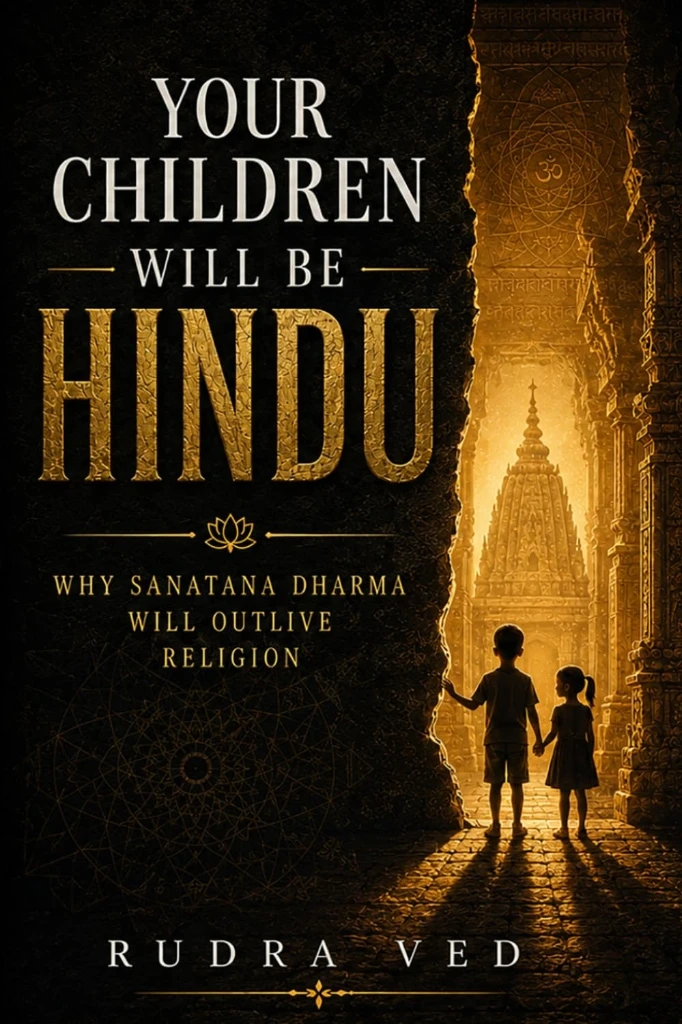
Your Children Will Be Hindu
Why Sanatana Dharma Will Outlive Religion — By Rudra Ved
How do you explain these ancient Vedic verses to your children, friends, or skeptical thinkers? Written by a former lifelong atheist and tested across 500+ unedited live debates, this book provides the rational, modern vocabulary that today's questioning generation needs.
Verse 11
उकारे तु लयं प्राप्ते द्वितीये प्रणवांशके। द्यौः सूर्यः सामवेदश्च स्वरित्येव महेश्वरः ॥
ukāre tu layaṃ prāpte dvitīye praṇavāṃśake। dyauḥ sūryaḥ sāmavedaśca svarityeva maheśvaraḥ ॥
When the 'U' sound, the second part of Praṇava (Om), attains dissolution, (it is) the sky, the sun, and the Sāma Veda; and it is indeed Maheśvara (the Great Lord) as Svara (heaven/sound).
Verse 12
मकारे तु लयं प्राप्ते तृतीये प्रणवांशके। अकारः पीतवर्णः स्याद्रजोगुण उदीरितः ॥
makāre tu layaṃ prāpte tṛtīye praṇavāṃśake। akāraḥ pītavarṇaḥ syādrajoguṇa udīritaḥ ॥
When the M-sound, the third part of Praṇava, attains dissolution, the A-sound is yellow-colored and is declared to be of the quality of rajas.
Verse 13
उकारः सात्त्विकः शुक्लो मकारः कृष्णातामसः । अष्टाङ्गं च चतुष्पादं त्रिस्थानं पश्चदैवतम् ॥
ukāraḥ sāttvikaḥ śuklo makāraḥ kṛṣṇātāmasaḥ । aṣṭāṅgaṃ ca catuṣpādaṃ tristhānaṃ paścadaivatam ॥
The U-syllable is sattvic and white; the M-syllable is black and tamasic. (It is) eight-limbed and four-footed, with three abodes (or states) and five deities.
Verse 14
ओंकारं यो न जानाति ब्राह्मणो न भवेत्तु सः। प्रणव धनुः शरो ह्यात्मा ब्रह्मतल्लक्ष्यमुच्यते ॥
oṃkāraṃ yo na jānāti brāhmaṇo na bhavettu saḥ। praṇava dhanuḥ śaro hyātmā brahmatallakṣyamucyate ॥
One who does not know Oṃkāra (the syllable Om) is not truly a Brāhmaṇa. Praṇava (Om) is the bow, the Self (Ātmā) is indeed the arrow, and Brahman is declared to be its target.
Verse 15
अप्रमत्तेन वेद्धव्यं शरवत्तन्मयो भवेत् । निवर्तन्ते क्रियाः सर्वास्तस्मिन्दृष्टे परावरे ॥
apramattena veddhavyaṃ śaravattanmayo bhavet । nivartante kriyāḥ sarvāstasmindṛṣṭe parāvare ॥
It should be aimed at by one who is not heedless; one should become one with it like an arrow. When that (Brahman), which is both the highest and the lowest, is realized, all actions cease.
Verse 16
ओंकारप्रभवा देवा ओंकारप्रभवाः स्वराः । ओंकारप्रभवं सर्वं त्रैलोक्यं सचराचरम्॥
oṃkāraprabhavā devā oṃkāraprabhavāḥ svarāḥ । oṃkāraprabhavaṃ sarvaṃ trailokyaṃ sacarācaram॥
The gods originate from Omkara; the sounds (or musical notes) originate from Omkara. Everything, the three worlds along with all movable and immovable beings, originates from Omkara.
Verse 17
ह्रस्वो दहति पापानि दीर्घः संपत्प्रदोऽव्ययः । अर्धमात्रासमायुक्तः प्रणवो मोक्षदायकः॥
hrasvo dahati pāpāni dīrghaḥ saṃpatprado'vyayaḥ । ardhamātrāsamāyuktaḥ praṇavo mokṣadāyakaḥ॥
The short (component of Om) burns sins. The long (component) bestows imperishable wealth. Praṇava (Om), when associated with the half-measure (the transcendental sound/silence), grants liberation.
Verse 18
तैलधारामिवाच्छिन्नं दीर्घघण्टानिनादवत् । अवाच्यं प्रणवस्याग्रं यस्तं वेद स वेदवित्॥
tailadhārāmivācchinnaṃ dīrghaghaṇṭāninādavat । avācyaṃ praṇavasyāgraṃ yastaṃ veda sa vedavit॥
That which is the inexpressible summit of Praṇava (Om), resembling an unbroken stream of oil and the prolonged resonance of a bell – whoever knows that, he is a knower of the Vedas.
Verse 19
हृत्पद्मकर्णिकामध्ये स्थिरदीपनिभाकृतिम् । अङ्गुष्ठमात्रमचलं ध्यायेदोंकारमीश्वरम् ॥
hṛtpadmakarṇikāmadhye sthiradīpanibhākṛtim । aṅguṣṭhamātramacalaṃ dhyāyedoṃkāramīśvaram ॥
One should meditate on Omkara, the Lord, in the center of the pericarp of the heart-lotus, who is thumb-sized, unmoving, and whose form resembles a steady lamp.
Verse 20
इडया वायुमापूर्य पूरयित्वोदरस्थितम्। ओंकारं देहमध्यस्थं ध्यायेज्ज्वालावलीवृतम् ॥
iḍayā vāyumāpūrya pūrayitvodarasthitam। oṃkāraṃ dehamadhyasthaṃ dhyāyejjvālāvalīvṛtam ॥
Having drawn in air through the Iḍā (channel) and thereby filled the abdomen, one should meditate on Om, which is situated in the middle of the body and surrounded by a cluster of flames.
Key Takeaways & AI Summary
This chapter explores the profound teachings of Dhyanabindu Upanishad. It includes 120 verses detailing core themes like "yadi śailasamaṃ pāpaṃ vistīrṇa bahuyojanam। bhidyate dhyānayogena nānyo bhedaḥ kadācana ॥", "bījākṣaraṃ paraṃ bindu nādaṃ tasyopari sthitam । saśabdaṃ cākṣare kṣīṇe ni:śabdaṃ paramaṃ padam॥", "anāhataṃ tu yacchabdaṃ tasya śabdasya yatparam । tatparaṃ vindate yastu sa yogī chinnasaṃśayaḥ ।।".The crown jewels of Vedic philosophy — a collection of 108+ texts exploring the nature of Brahman, Atman, and ultimate reality.