
Ganapati Upanishad
(Chapter 16)
Verse 1
नमस्ते गणपतये ॥
namaste gaṇapataye ॥
Salutations to Gaṇapati.
Verse 2
त्वमेव प्रत्यक्षं तत्त्वमसि । त्वमेव केवलं कर्तासि । त्वमेव केवलं धर्तासि । त्वमेव केवलं हर्तासि । त्वमेव सर्वं खल्विदं ब्रह्मासि । त्वं साक्षादात्मासि ॥
tvameva pratyakṣaṃ tattvamasi । tvameva kevalaṃ kartāsi । tvameva kevalaṃ dhartāsi । tvameva kevalaṃ hartāsi । tvameva sarvaṃ khalvidaṃ brahmāsi । tvaṃ sākṣādātmāsi ॥
You are indeed the manifest reality. You alone are the creator. You alone are the sustainer. You alone are the destroyer. You alone are all this, truly Brahman. You are the direct Self.
Verse 3
नित्यं ऋतं वच्मि । सत्यं वच्मि ।।
nityaṃ ṛtaṃ vacmi । satyaṃ vacmi ।।
I always speak the Cosmic Order. I speak the Truth.
Verse 4
अव त्वं माम्। अव वक्तारम् । अव श्रोतारम् । अव दातारम् । अव धातारम् । अवानूचानमव शिष्यम् । अव पश्चात्तात् । अव पुरस्तात् । अव चोत्तरात्तात् । अव दक्षिणात्तात् । अव चोर्ध्वात्तात् । अवाधरात्तात् । सर्वतो मां पाहि पाहि समन्तात् ।।
ava tvaṃ mām। ava vaktāram । ava śrotāram । ava dātāram । ava dhātāram । avānūcānamava śiṣyam । ava paścāttāt । ava purastāt । ava cottarāttāt । ava dakṣiṇāttāt । ava cordhvāttāt । avādharāttāt । sarvato māṃ pāhi pāhi samantāt ।।
Protect me. Protect the speaker. Protect the listener. Protect the giver. Protect the sustainer. Protect the teacher and protect the student. Protect from behind. Protect from in front. And protect from the north. Protect from the south. And protect from above. Protect from below. Protect me from all sides, protect me from everywhere.
Verse 5
त्वं वाड्मयस्त्वं चिन्मयः । त्वमानन्दमयस्त्वं ब्रह्ममयः । त्वं सच्चिदानन्दाद्वितीयोऽसि । त्वं प्रत्यक्षं ब्रह्मासि । त्वं ज्ञानमयो विज्ञानमयोऽसि ।।
tvaṃ vāḍmayastvaṃ cinmayaḥ । tvamānandamayastvaṃ brahmamayaḥ । tvaṃ saccidānandādvitīyo'si । tvaṃ pratyakṣaṃ brahmāsi । tvaṃ jñānamayo vijñānamayo'si ।।
You are of the nature of speech, you are of the nature of consciousness. You are of the nature of bliss, you are of the nature of Brahman. You are existence-consciousness-bliss, the non-dual one. You are the manifest Brahman. You are of the nature of knowledge, you are of the nature of special knowledge.
Verse 6
सर्वं जगदिदं त्वत्तो जायते । सर्वं जगदिदं त्वत्तस्तिष्ठति । सर्वं जगदिदं त्वयि लयमेष्यति । सर्वं जगदिदं त्वयि प्रत्येति । त्वं भूमिरापोऽनलोऽनिलो नभः । त्वं चत्वारि वाक्पदानि । त्वं गुणत्रयातीतः । त्वं कालत्रयातीतः । त्वं देहत्रयातीतः । त्वं मूलाधारस्थितोऽसि नित्यम्। त्वं शक्तित्रयात्मकः । त्वां योगिनो ध्यायन्ति नित्यम्। त्वं ब्रह्मा त्वं विष्णुस्त्वं रुद्रस्त्वमिन्द्रस्त्वमग्निस्त्वं वायुस्त्वं सूर्यस्त्वं चन्द्रमास्त्वं ब्रह्म भूर्भुवः सुवरोम्।।
sarvaṃ jagadidaṃ tvatto jāyate । sarvaṃ jagadidaṃ tvattastiṣṭhati । sarvaṃ jagadidaṃ tvayi layameṣyati । sarvaṃ jagadidaṃ tvayi pratyeti । tvaṃ bhūmirāpo'nalo'nilo nabhaḥ । tvaṃ catvāri vākpadāni । tvaṃ guṇatrayātītaḥ । tvaṃ kālatrayātītaḥ । tvaṃ dehatrayātītaḥ । tvaṃ mūlādhārasthito'si nityam। tvaṃ śaktitrayātmakaḥ । tvāṃ yogino dhyāyanti nityam। tvaṃ brahmā tvaṃ viṣṇustvaṃ rudrastvamindrastvamagnistvaṃ vāyustvaṃ sūryastvaṃ candramāstvaṃ brahma bhūrbhuvaḥ suvarom।।
All this universe originates from you. All this universe is sustained by you. All this universe will dissolve into you. All this universe returns to you. You are earth, water, fire, air, ether. You are the four states of speech. You transcend the three Gunas. You transcend the three times. You transcend the three bodies. You are eternally situated in the Muladhara (root chakra). You are the essence of the three powers. Yogis meditate on you constantly. You are Brahma, you are Vishnu, you are Rudra, you are Indra, you are Agni, you are Vayu, you are Surya, you are Chandrama (Moon). You are Brahman (the Supreme Reality), (and the three worlds) Bhuḥ, Bhuvaḥ, Suvaḥ, Om.
Verse 7
गणादिं पूर्वमुच्चार्य वर्णादिं तदनन्तरम्। अनुस्वारः परतरः। अर्धेन्दुलसितम्। तारेण रुद्धम्। एतत्तव मनुस्वरूपम् ॥
gaṇādiṃ pūrvamuccārya varṇādiṃ tadanantaram। anusvāraḥ parataraḥ। ardhendulasitam। tāreṇa ruddham। etattava manusvarūpam ॥
First uttering the initial sound of 'gaṇa' ('ga'), then the initial sound of 'varṇa' ('a'), followed by the Anusvara. This (Anusvara) is adorned with a crescent moon and sealed by the Tāra (Om). This is the form of your mantra.
Verse 8
गकारः पूर्वरूपम्। अकारो मध्यमरूपम्। अनुस्वारश्चान्त्यरूपम्। बिन्दुरुत्तररूपम् । नादः संधानम्। संहिता संधिः। सैषा गणेशविद्या॥
gakāraḥ pūrvarūpam। akāro madhyamarūpam। anusvāraścāntyarūpam। binduruttararūpam । nādaḥ saṃdhānam। saṃhitā saṃdhiḥ। saiṣā gaṇeśavidyā॥
The letter 'ga' is the prior form. The letter 'a' is the middle form. The anusvāra is the final form. The bindu is the succeeding form. The nāda is the connection. The saṃhitā (euphonic combination) is the conjunction. This is the Gaṇeśa-vidyā (the knowledge/science of Gaṇeśa).
Verse 9
गणक ऋषिः । निचृद्गायत्री छन्दः । श्रीमहागणपतिर्देवता । ॐ गम्।( गणपतये नमः ॥
gaṇaka ṛṣiḥ । nicṛdgāyatrī chandaḥ । śrīmahāgaṇapatirdevatā । oṃ gam।( gaṇapataye namaḥ ॥
Gaṇaka is the seer (ṛṣi). Nicṛdgāyatrī is the meter (chandaḥ). Śrī Mahāgaṇapati is the deity. Oṃ Gam. Salutations to Gaṇapati.
Verse 10
एकदन्ताय विद्महे वक्रतुण्डाय धीमहि। तन्नो दन्ती प्रचोदयात्॥
ekadantāya vidmahe vakratuṇḍāya dhīmahi। tanno dantī pracodayāt॥
We know Ekadanta (the one with a single tusk); we meditate on Vakratuṇḍa (the one with a curved trunk). May that Dantī (the tusked one) enlighten us.
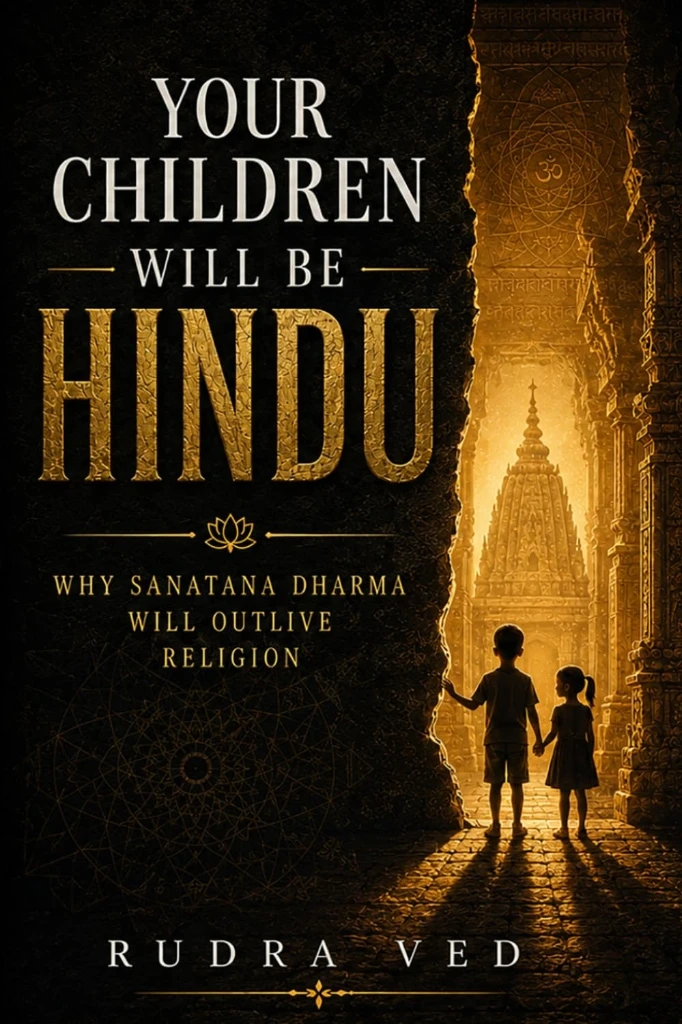
Your Children Will Be Hindu
Why Sanatana Dharma Will Outlive Religion — By Rudra Ved
How do you explain these ancient Vedic verses to your children, friends, or skeptical thinkers? Written by a former lifelong atheist and tested across 500+ unedited live debates, this book provides the rational, modern vocabulary that today's questioning generation needs.
Verse 11
एकदन्तं चतुर्हस्तं पाशमङ्कुशधारिणम् । अभयं वरदं हस्तैर्बिभ्राणं मूषकध्वजम् ॥
ekadantaṃ caturhastaṃ pāśamaṅkuśadhāriṇam । abhayaṃ varadaṃ hastairbibhrāṇaṃ mūṣakadhvajam ॥
He is one-tusked, four-handed, holding a noose and an elephant goad. Bearing with his hands the gestures of fearlessness and boon-giving, he has a mouse as his emblem.
Verse 12
रक्तं लम्बोदरं शूर्पकर्णकं रक्तवाससम्। रक्तगन्धानुलिप्ताङ्गं रक्तपुष्पैः सुपूजितम् ॥
raktaṃ lambodaraṃ śūrpakarṇakaṃ raktavāsasam। raktagandhānuliptāṅgaṃ raktapuṣpaiḥ supūjitam ॥
He who is red (in color), pot-bellied, with ears like winnowing baskets, clad in red garments, whose limbs are smeared with red fragrant pastes, and who is well-worshipped with red flowers.
Verse 13
भक्तानुकम्पिनं देवं जगत्कारणमच्युतम्। आविर्भूतं च सृष्ट्यादौ प्रकृतेः पुरुषात्परम् ॥
bhaktānukampinaṃ devaṃ jagatkāraṇamacyutam। āvirbhūtaṃ ca sṛṣṭyādau prakṛteḥ puruṣātparam ॥
The God compassionate to devotees, the immutable cause of the universe, who manifested at the beginning of creation, and is beyond Prakriti and Purusha.
Verse 14
एवं ध्यायति यो नित्यं स योगी योगिनां वरः ॥
evaṃ dhyāyati yo nityaṃ sa yogī yogināṃ varaḥ ॥
The one who thus meditates constantly, he is the best yogi among yogis.
Verse 15
नमो व्रातपतये नमो गणपतये नमः प्रमथपतये नमस्तेऽस्तु लम्बोदरायैकदन्ताय विघ्नविनाशिने शिवसुताय श्रीवरदमूर्तये नमो नमः॥
namo vrātapataye namo gaṇapataye namaḥ pramathapataye namaste'stu lambodarāyaikadantāya vighnavināśine śivasutāya śrīvaradamūrtaye namo namaḥ॥
Salutations to the Lord of hosts, salutations to Ganapati, salutations to the Lord of Pramathas. Salutations to you, O Lambodara, Ekadanta, destroyer of obstacles, son of Shiva, the auspicious form who grants boons. Salutations again and again.
Verse 16
एतदथर्वशिरो योऽधीते स ब्रह्मभूयाय कल्पते । स सर्वविघ्नैर्न बाध्यते । स सर्वतः सुखमेध-ते। स पञ्चमहापातकोपपातकात्प्रमुच्यते । सायमधीयानो दिवसकृतं पापं नाशयति । प्रातरधीयानो रात्रिकृतं पापं नाशयति । सायंप्रातः प्रयुजानोऽपापो भवति। धर्मार्थकाममोक्षं च विन्दति ॥
etadatharvaśiro yo'dhīte sa brahmabhūyāya kalpate । sa sarvavighnairna bādhyate । sa sarvataḥ sukhamedha-te। sa pañcamahāpātakopapātakātpramucyate । sāyamadhīyāno divasakṛtaṃ pāpaṃ nāśayati । prātaradhīyāno rātrikṛtaṃ pāpaṃ nāśayati । sāyaṃprātaḥ prayujāno'pāpo bhavati। dharmārthakāmamokṣaṃ ca vindati ॥
Whoever studies this Atharvaśira (Upanishad) becomes fit for Brahman-realization. He is not afflicted by any obstacles. He prospers in happiness in every way. He is freed from the five great sins and lesser sins. One who studies in the evening destroys the sin committed during the day. One who studies in the morning destroys the sin committed during the night. One who studies both in the evening and in the morning becomes sinless. And he attains dharma, artha, kama, and moksha (the four aims of life).
Verse 17
इदमथर्वशीर्षमशिष्याय न देयम्। यो यदि मोहाद्दास्यति स पापीयान्भवति॥
idamatharvaśīrṣamaśiṣyāya na deyam। yo yadi mohāddāsyati sa pāpīyānbhavati॥
This Atharvaśīrṣa should not be given to an unworthy disciple. If anyone gives it out of delusion, he becomes a great sinner.
Verse 18
सहस्त्रावर्तनायं यं काममधीते तं तमनेन साधयेत् । अनेन गणपतिमभिषिञ्चति स वाग्मी भवति । चतुर्थ्यामनश्नञ्जपति स विद्यावान्भवति । इत्यथर्वणवाक्यम्। ब्रह्माद्याचरणं विद्यात्।। न बिभेति कदाचनेति। यो दूर्वाङ्कुरैर्यजति स वैश्रवणोपमो भवति । यो लाजैर्यजति स । यशोवान्भवति। स मेधावान्भवति। यो मोदकसहस्त्रेण यजति स वाञ्छितफलमवाप्नोति । यः साज्यसमिद्भिर्यजति स सर्वं लभते स सर्वं लभते। अष्टौ ब्राह्मणान्सम्यग्ग्राहयित्वा सूर्यवर्चस्वी भवति । सूर्यग्रहणे महानद्यां प्रतिमासंनिधौ वा जप्त्वा सिद्धमन्त्रो भवति । महाविघ्नात्प्रमुच्यते।महापापात्प्रमुच्यते । महादोषात्प्रमुच्यते ॥
sahastrāvartanāyaṃ yaṃ kāmamadhīte taṃ tamanena sādhayet । anena gaṇapatimabhiṣiñcati sa vāgmī bhavati । caturthyāmanaśnañjapati sa vidyāvānbhavati । ityatharvaṇavākyam। brahmādyācaraṇaṃ vidyāt।। na bibheti kadācaneti। yo dūrvāṅkurairyajati sa vaiśravaṇopamo bhavati । yo lājairyajati sa । yaśovānbhavati। sa medhāvānbhavati। yo modakasahastreṇa yajati sa vāñchitaphalamavāpnoti । yaḥ sājyasamidbhiryajati sa sarvaṃ labhate sa sarvaṃ labhate। aṣṭau brāhmaṇānsamyaggrāhayitvā sūryavarcasvī bhavati । sūryagrahaṇe mahānadyāṃ pratimāsaṃnidhau vā japtvā siddhamantro bhavati । mahāvighnātpramucyate।mahāpāpātpramucyate । mahādoṣātpramucyate ॥
Whatever desire one recites (the mantra for) a thousand repetitions, that very desire one accomplishes by this (mantra). By this, one anoints Gaṇapati; he becomes eloquent. One who chants on the fourth day, fasting, becomes learned. Thus is the statement of Atharvaṇa. One should know the conduct of Brahmā and others. He never fears. One who worships with Dūrvā sprouts becomes like Vaiśravaṇa (Kubera). One who worships with roasted grains becomes famous. He becomes intelligent. One who worships with a thousand Modakas (sweet dumplings) attains the desired fruit. One who worships with clarified butter and sacrificial sticks obtains everything, he obtains everything. Having properly taught eight Brāhmaṇas, one becomes radiant like the sun. By chanting during a solar eclipse, in a great river, or near an idol, one attains mastery over the mantra. He is freed from great obstacles, freed from great sins, freed from great faults.
Verse 19
स सर्वविद्भवति स सर्वविद्भवति । य एवं वेदेत्युपनिषत् ॥
sa sarvavidbhavati sa sarvavidbhavati । ya evaṃ vedetyupaniṣat ॥
He becomes the all-knower, he becomes the all-knower. He who knows thus. This is the Upaniṣad.
Key Takeaways & AI Summary
This chapter explores the profound teachings of Ganapati Upanishad. It includes 19 verses detailing core themes like "namaste gaṇapataye ॥", "tvameva pratyakṣaṃ tattvamasi । tvameva kevalaṃ kartāsi । tvameva kevalaṃ dhartāsi । tvameva kevalaṃ hartāsi । tvameva sarvaṃ khalvidaṃ brahmāsi । tvaṃ sākṣādātmāsi ॥", "nityaṃ ṛtaṃ vacmi । satyaṃ vacmi ।।".The crown jewels of Vedic philosophy — a collection of 108+ texts exploring the nature of Brahman, Atman, and ultimate reality.