
Mandukya Upanishad
(Chapter 2)
Verse 1
हरिः ॐ । ॐ इत्येतदक्षरमिदं सर्वम् । तस्योपव्याख्यानं भूतं भवद्भविष्यदिति सर्वमोङ्कार एव । यच्चान्यत् त्रिकालातीते तदप्योङ्कार एव ॥१॥
hariḥ oṃ. oṃ ity etad akṣaram idaṃ sarvam; tasyopavyākhyānaṃ bhūtaṃ bhavad bhaviṣyad iti sarvam oṅkāra eva; yaccānyat trikālātīte tad apy oṅkāra eva ..1..
Om, the syllable, is all this. Whatever was, is, or will be is truly Om; and what is beyond the three times is also Om.
Verse 2
सर्वं ह्येतद्ब्रह्मायमात्मा ब्रह्म सोऽयमात्मा चतुष्पात् ॥२॥
sarvaṃ hy etad brahma; ayam ātmā brahma; so 'yam ātmā catuṣpāt ..2..
All this is Brahman. This Self is Brahman. And this very Self has four quarters (aspects).
Verse 3
जाग्रत्स्थानो बहिष्प्रज्ञः सप्ताङ्ग एकोनविंशतिमुखः स्थूलभुक् वैश्वानरः प्रथमः पादः ॥३॥
jāgrat-sthāno bahiṣ-prajñaḥ saptāṅga ekonaviṃśati-mukhaḥ sthūlabhuk vaiśvānaraḥ prathamaḥ pādaḥ ..3..
The waking-state Self is outwardly conscious, with seven limbs and nineteen mouths, experiencing gross objects—this is Vaiśvānara, the first quarter.
Verse 4
स्वप्नस्थानोऽन्तःप्रज्ञः सप्ताङ्ग एकोनविंशतिमुखः प्रविविक्तभुक् तैजसः द्वितीयः पादः ॥४॥
svapna-sthāno 'ntaḥ-prajñaḥ saptāṅga ekonaviṃśati-mukhaḥ praviviktabhuk taijasaḥ dvitīyaḥ pādaḥ ..4..
The dream-state Self is inwardly conscious, with seven limbs and nineteen mouths, experiencing subtle objects—this is Taijasa, the second quarter.
Verse 5
सुषुप्तस्थान एकीभूतः प्रज्ञानघन एवाऽऽनन्दमयो ह्यानन्दभुक् चेतोमुखः प्राज्ञस्तृतीयः पादः ॥५॥
suṣupta-sthāna ekībhūtaḥ prajñānaghana evā'nandamayo hy ānanda-bhuk ceto-mukhaḥ prājñas tṛtīyaḥ pādaḥ ..5..
In deep sleep, the Self is unified, a mass of consciousness, verily blissful, a enjoyer of bliss, with mind as the doorway—this is Prājña, the third quarter.
Verse 6
एष सर्वेश्वरः एष सर्वज्ञः एषोऽन्तर्याम्येष योनिः सर्वस्य प्रभवाप्ययौ हि भूतानाम् ॥६॥
eṣa sarveśvaraḥ eṣa sarvajñaḥ eṣo'ntaryāmī eṣa yoniḥ sarvasya; prabhavāpyayau hi bhūtānām ..6..
He is the Lord of all, the omniscient, the inner controller, the source of all; for he is the origin and dissolution of beings.
Verse 7
नान्तःप्रज्ञं न बहिष्प्रज्ञं नोभयतःप्रज्ञं न प्रज्ञानघनं न प्रज्ञं नाप्रज्ञम् । अदृष्टमव्यवहार्यमग्राह्यमलक्षणमचिन्त्यमव्यपदेश्यमेकात्मप्रत्ययसारं प्रपञ्चोपशमं शान्तं शिवमद्वैतं चतुर्थं मन्यन्ते स आत्मा स विज्ञेयः ॥७॥
nāntaḥ-prajñaṃ na bahiṣ-prajñaṃ nobhayataḥ-prajñaṃ na prajñānaghanaṃ na prajñaṃ nāprajñam; adṛṣṭam avyavahāryam agrāhyam alakṣaṇam acintyam avyapadeśyam ekātma-pratyaya-sāraṃ prapañcopaśamaṃ śāntaṃ śivam advaitaṃ caturthaṃ manyante sa ātmā sa vijñeyaḥ ..7..
The Fourth is neither inwardly conscious nor outwardly conscious nor both, neither a mass of consciousness nor simple consciousness nor non‑conscious. Unseen, beyond transactions, not graspable, without marks, unthinkable, indescribable; the essence of self‑awareness; the cessation of all phenomena; peaceful, auspicious, non‑dual—this they consider the Fourth: that is the Self, to be realized.
Verse 8
सोऽयमात्माऽध्यक्षरमोङ्कारोऽधिमात्रा । पादा मात्रा मात्राś्च पादाः । अकार उकारो मकार इति ॥८॥
so 'yam ātmā 'dhyakṣaram oṅkāro 'dhimātrā; pādā mātrā mātrāś ca pādāḥ; akāra ukāro makāra iti ..8..
This very Self, with regard to the syllable, is Om; with regard to its measures, the quarters correspond to the measures: A, U, and M.
Verse 9
जागरितस्थानो वैश्वानरोऽकारः प्रथमामात्रा आप्तेरादिमत्वाद्वा आप्नोति ह वै सर्वान्कामानादिश्च भवति य एवं वेद ॥९॥
jāgarita-sthāno vaiśvānaro 'kāraḥ prathamā mātrā; āpter ādimatvād vā; āpnoti ha vai sarvān kāmān ādiś ca bhavati ya evaṃ veda ..9..
The waking Vaiśvānara is A, the first measure—because of obtaining and being first. He who knows thus obtains all desires and becomes the first (leader).
Verse 10
स्वप्नस्थानस्तैजस उकारो द्वितीया मात्रा उत्कर्षादुभयत्वाद्वा ऊर्ध्व उन्नीयते ह वै ज्ञानसन्ततिं समनश्च भवति नास्याब्रह्मवित्कुले भवति य एवं वेद ॥१०॥
svapna-sthānas taijasa ukāro dvitīyā mātrā; utkarṣād ubhayatvād vā; ūrdhva unnīyate ha vai jñāna-santatiṃ samanāś ca bhavati nāsyābrahmavit-kule bhavati ya evaṃ veda ..10..
The dream Taijasa is U, the second measure—because of exaltation and intermediateness. He who knows thus raises high the stream of knowledge, becomes balanced, and no non‑knower of Brahman is born in his lineage.
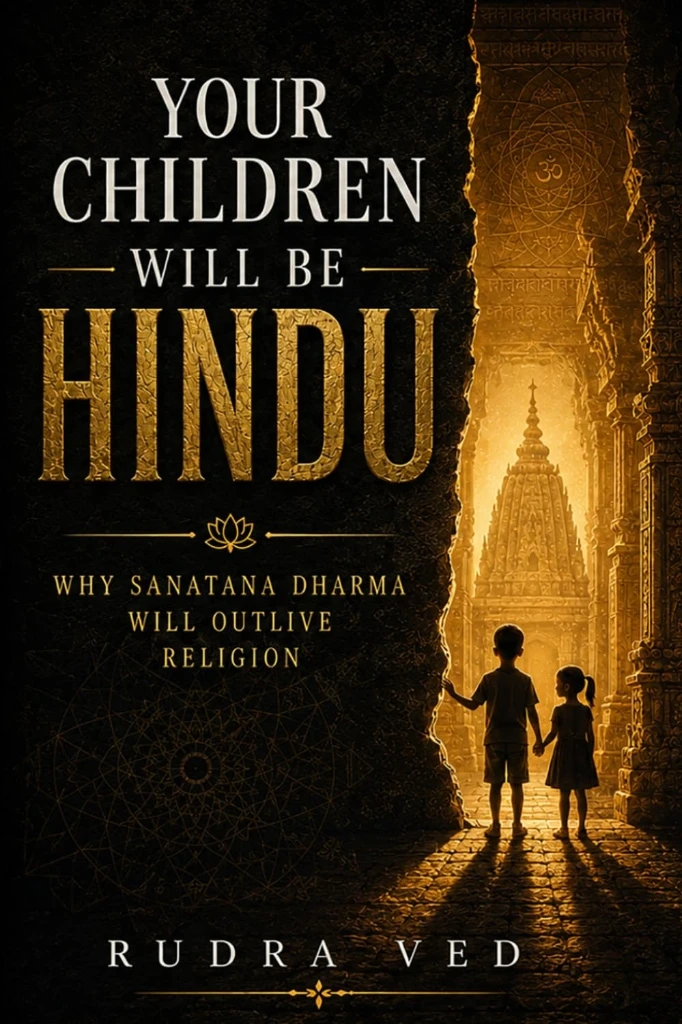
Your Children Will Be Hindu
Why Sanatana Dharma Will Outlive Religion — By Rudra Ved
How do you explain these ancient Vedic verses to your children, friends, or skeptical thinkers? Written by a former lifelong atheist and tested across 500+ unedited live debates, this book provides the rational, modern vocabulary that today's questioning generation needs.
Verse 11
सुषुप्तस्थानः प्राज्ञो मकारस्तृतीया मात्रा मितेरपीतेर्वा मिनोति ह वा इदं सर्वम् आपीतिश्च भवति य एवं वेद ॥११॥
suṣupta-sthānaḥ prājño makāras tṛtīyā mātrā; miter apīter vā; minoti ha vā idaṃ sarvam apītiś ca bhavati ya evaṃ veda ..11..
The deep‑sleep Prājña is M, the third measure—because of measure or absorption. He who knows thus measures (encompasses) all this and becomes the absorber.
Verse 12
अमात्रश्चतुर्थोऽव्यवहार्यः प्रपञ्चोपशमः शिवोऽद्वैत एवमोङ्कार आत्मैव । स आत्मा विज्ञेयः ॥१२॥
amātraś caturtho 'vyavahāryaḥ prapañcopaśamaḥ śivo 'dvaita evam oṅkāra ātmāiva; sa ātmā vijñeyaḥ ..12..
The Fourth is without measure, beyond transactions, the cessation of phenomena, auspicious, non‑dual. Thus Om itself is the Self; that Self is to be realized.
Key Takeaways & AI Summary
This chapter explores the profound teachings of Mandukya Upanishad. It includes 12 verses detailing core themes like "hariḥ oṃ", "sarvaṃ hy etad brahma", "jāgrat-sthāno bahiṣ-prajñaḥ saptāṅga ekonaviṃśati-mukhaḥ sthūlabhuk vaiśvānaraḥ prathamaḥ pādaḥ ".The crown jewels of Vedic philosophy — a collection of 108+ texts exploring the nature of Brahman, Atman, and ultimate reality.