
The Evidence of the Unseen: How the Minor Upanishads Prove God Exists
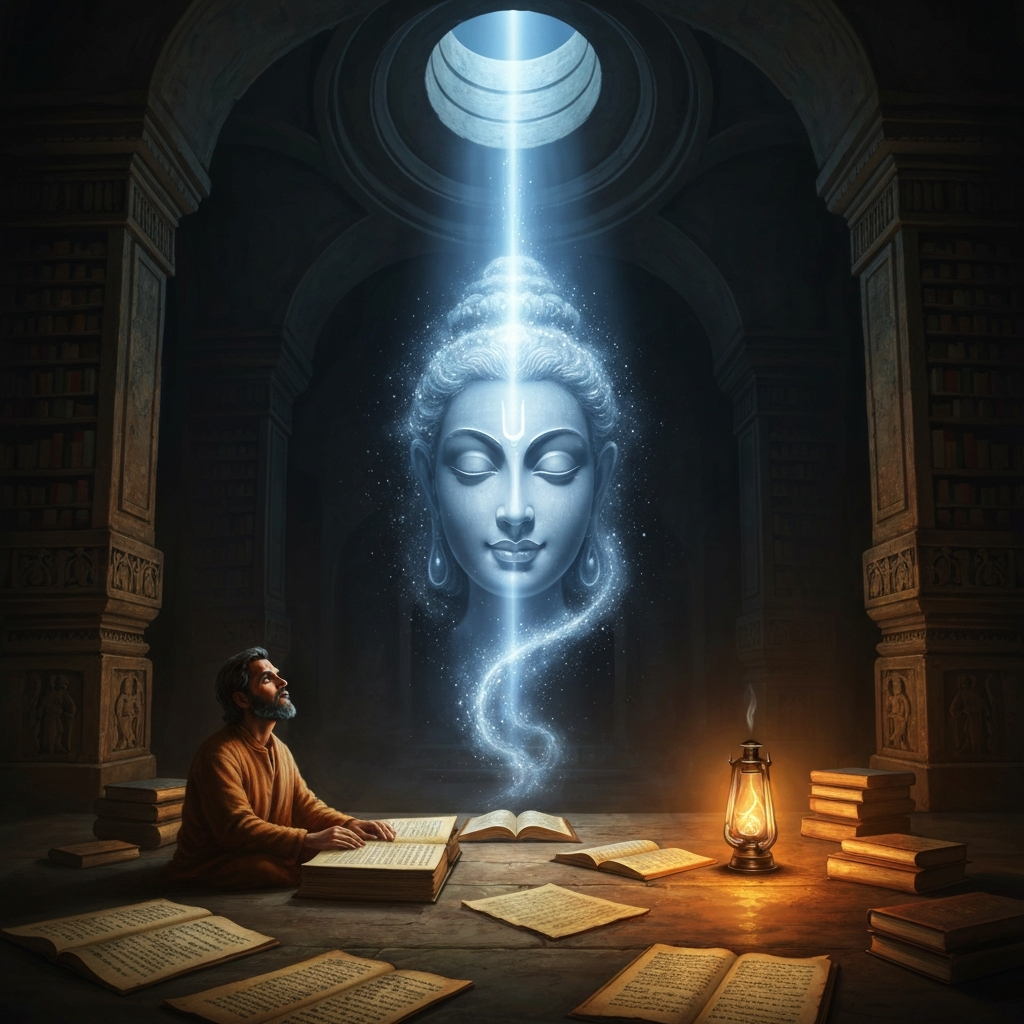
When we talk about Vedanta, we usually reference the "Big Ten" (Mukhya) Upanishads. These texts are famous for their high philosophy, focusing on Brahman—the abstract, non-dual Reality.
But what about the other 98?
The so-called "Minor" Upanishads—spanning the Yoga, Vaishnava, Shaiva, Shakta, and Sannyasa schools—offer something the major texts often skip: a robust, theistic affirmation of God (Ishvara). In these texts, the question "Does God exist?" is not answered with logic alone, but with sectarian devotion and experimental methodology.
Here is how these ancient texts move from an abstract principle to a personal, perceivable Deity.
1. Defining the Divine: Who is Ishvara?
The Niralamba Upanishad acts as a glossary for the seeker, explicitly bridging the gap between the formless Absolute and the personal God.
When asked "Who is Ishvara?", the text provides a distinct definition: Ishvara is consciousness conditioned by Maya (creative power). This resolves the eternal debate between theist and atheist. The text posits that God exists as the functional aspect of the Ultimate Reality. While Brahman is the static screen, Ishvara is the movie playing upon it—the active creator, sustainer, and destroyer.
2. The Sectarian Proofs: From "Something" to "Someone"
Unlike the generalized "Being" of the major texts, the Minor Upanishads prove God's existence by identifying Him with specific cosmic personalities.
The Vaishnava Proof (The Material Cause)
The Subala Upanishad uses a cosmological argument. It describes the cycle of Pralaya (dissolution), where earth merges into water, water into fire, and so on, until the entire universe collapses into a single point of darkness (Tamas), which finally merges into the Supreme Lord (Pare Deve).
The logic is simple: Since the universe dissolves into a single intelligent point, it must have arisen from that same point. The Gopala Tapani Upanishad takes this further, identifying Krishna not just as a historical figure, but as the entity that existed before time to enlighten Brahma (the creator).
The Shaiva Proof (The Underlying Unity)
The Atharvasiras Upanishad argues for the existence of Rudra (Shiva) as the substrate of reality. It states: "Rudra is that which exists now or will be created in the future."
Here, the proof of God is the unity of the cosmos. He is described as the "eyes" and "ears" of the universe—the intelligence that allows the cosmos to perceive itself.
The Shakta Proof (The Kinetic Energy)
The Tripura Tapini Upanishad posits that the male Trinity (Brahma, Vishnu, Rudra) are dormant without the primordial feminine power. It argues that God exists as the Shakti—the Kinetic Energy that forces the static Absolute to burst forth into creation.
3. The Yogic "Proof": The Lab Experiment
Perhaps the most fascinating contribution comes from the 20 Yoga Upanishads (such as the Tejobindu and Nadabindu). They do not ask you to believe in God; they ask you to perform an experiment.
- The Visual Evidence: The Tejobindu Upanishad describes God as the "Effulgent Point" within the heart. It argues that by controlling the mind, one can physically locate this point of intense consciousness.
- The Auditory Evidence: The Nadabindu Upanishad offers empirical proof through Anahata Nada (inner sound). It claims that when the yogi withdraws the senses, they can hear internal sounds—resembling the roar of the ocean, thunder, or bells. This auditory data is presented as direct evidence of the Antaryamin (Inner Controller).
4. The Argument from Pessimism
Finally, the Maitrayani Upanishad offers an argument based on the "filth" of the world. King Brihadratha asks a haunting question:
"What is the use of the enjoyment of pleasures in this body which is a mass of bones, skin, sinews, marrow, flesh... and ordure?"
The argument here is one of necessity. Because the material world is inherently decaying and insufficient, a Satyasya Satyam (Truth of Truths) must exist as a refuge. God exists because the human spirit cannot find satisfaction in dead matter.
Conclusion
According to the 98 Minor Upanishads, the answer to "Does God exist?" is a definitive Yes, but with specific qualifications:
- He exists as the Material Cause (the substance of the universe).
- He exists as the Inner Sound (verifiable through Yoga).
- He exists as the Refuge (the answer to worldly suffering).
God is not just a hypothesis; in these texts, He is an experience waiting to be had.
Discover Wisdom
Explore answers to life's biggest questions from the Vedas.
Black Moon (Lilith) Isn’t “Bad”—It’s Your Hidden Power Switch
When the moon disappears, your deepest desires speak. Discover what reveals—and how to work with it.
Shiva Lingam Explained: The Meaning Most People Never Hear
Not what you’ve been told. Uncover the spiritual (and surprisingly logical) reality behind the symbol.
Create Your Own Luck: The Ancient Formula for Success
Stop waiting for a miracle. Chapter 18 reveals the 5 exact factors that determine the outcome of any action.