
110%
Philosophy
The Manusmriti Misconception: Understanding the True Foundations of Hindu Philosophy
VVedaSeek Team
•June 24, 2026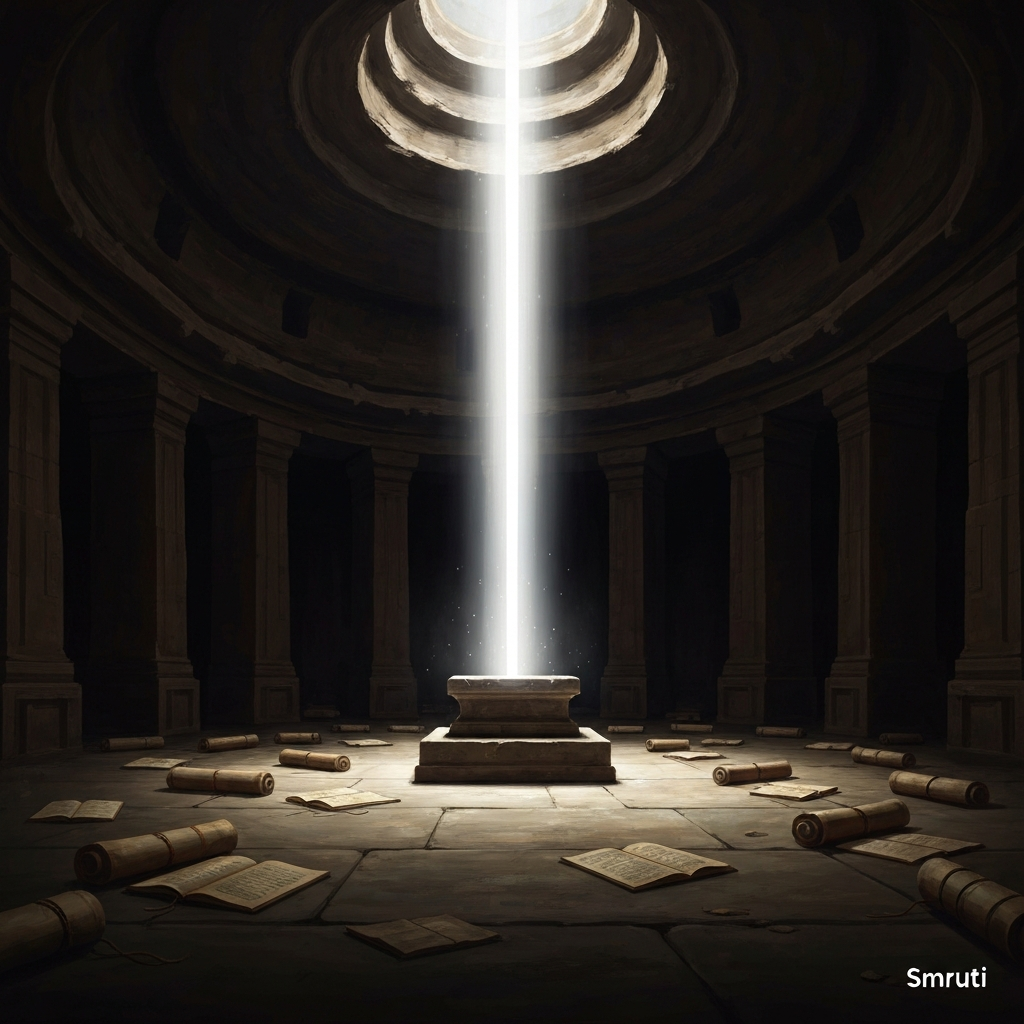
7 min read
In academic circles, historical discussions, and contemporary debates about Hinduism, a familiar critique frequently emerges: Hinduism is inherently oppressive because its foundational text, the Manusmriti, enforces a rigid, birth-based social hierarchy designed to subjugate people.
To address this critique honestly, one must first acknowledge a core fact: The Manusmriti does indeed contain strict, exclusionary, and often harsh social codes based on birth. If one assumes this text serves as the absolute, eternal constitution of Hindu theology, the criticism appears entirely valid.
However, this argument rests on a fundamental misunderstanding of Hindu jurisprudence and theology. Treating a temporal, localized social manual as the eternal framework of a 5,000-year-old civilization distorts the reality of how Hindu authority actually operates. To evaluate the spiritual and philosophical core of Hinduism through the lens of the Manusmriti is to mistake a historical sociological text for universal scripture like the Upanishads or the Bhagavad Gita.
Shruti vs. Smriti: The Textual Hierarchy
To understand Hindu philosophy, one must understand its textual hierarchy. Hindu scriptures are strictly divided into two categories:
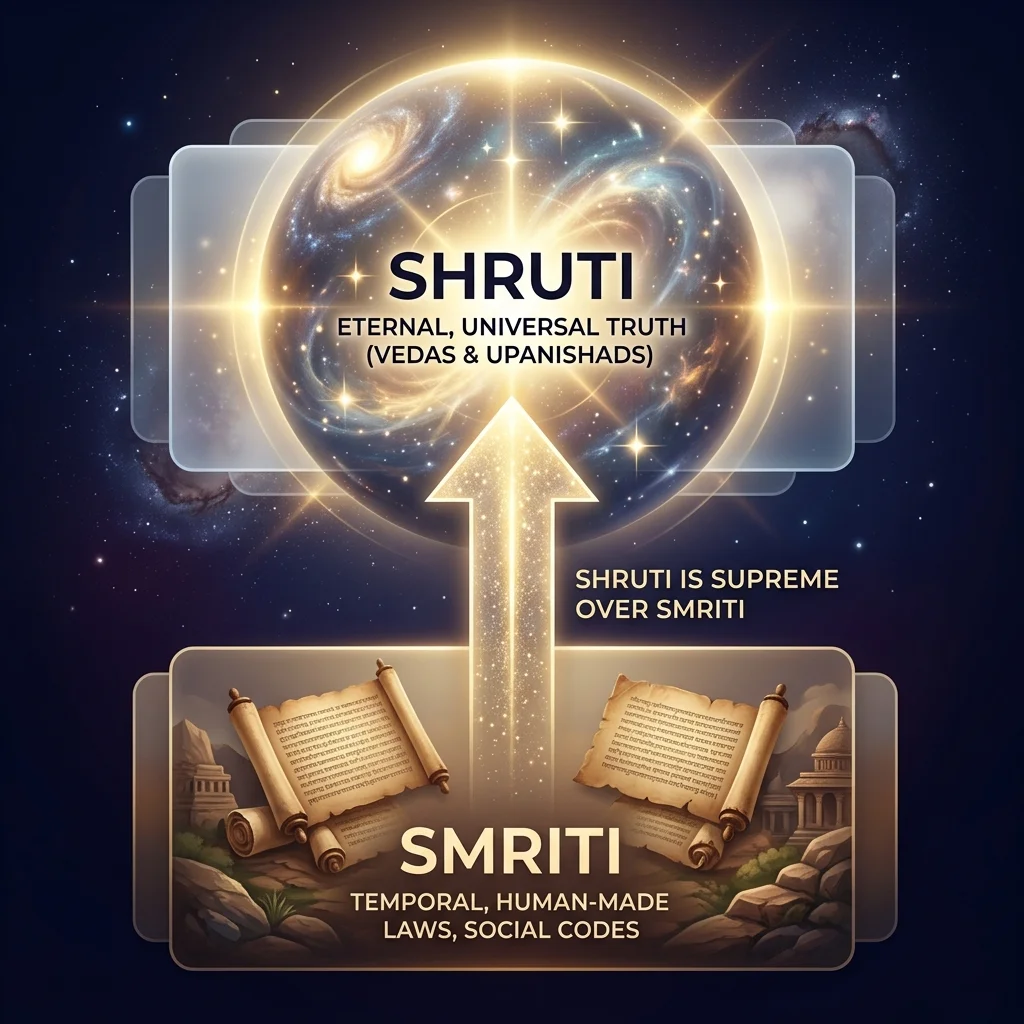
- Shruti ("That which is heard"): These are the Vedas and the Upanishads. They are considered eternal, universal, and foundational spiritual truths. They deal with the nature of reality, consciousness, the universe, and the soul.
- Smriti ("That which is remembered"): These are social codes, historical epics, and legal frameworks written by humans for specific time periods, geographies, and societal structures. The Manusmriti falls squarely into this category.
There is a long-established maxim in traditional Hindu jurisprudence governing these texts:
श्रुतिस्मृतिविरोधे तु श्रुतिरेव गरीयसी śrutismṛtivirodhe tu śrutireva garīyasī "When there is a conflict between Shruti and Smriti, the Shruti alone is the supreme authority."
Adi Shankaracharya, the 8th-century philosopher who consolidated Advaita Vedanta, explicitly settled this in his seminal commentary on the Brahma Sutras (Adhyaya 2, Pada 1, Sutra 1 — Smrityadhikarana). He ruled that Smritis are valid only as long as they follow the spiritual blueprint of the Shruti. If a human-made social code contradicts the eternal philosophy of the Vedas, the Smriti is to be discarded.
Therefore, defining the Hindu worldview by the Manusmriti deliberately ignores the religion's actual supreme authority.
The Evidence of the Eternal Texts
When we shift our focus from outdated social manuals to the foundational Shruti, the narrative of an inherently birth-based, oppressive theology dissolves.
The Equality of Consciousness (Isha Upanishad)
The philosophical core of the Upanishads is Advaita (non-dualism)—the principle that the exact same divine spark (Atman) exists equally within every living being.
Location: Isha Upanishad, Mantra 6
यस्तु सर्वाणि भूतान्यात्मन्येवानुपश्यति । सर्वभूतेषु चात्मानं ततो न विजुगुप्सते ॥ Yastu sarvāṇi bhūtānyātmanyevānupaśyati | sarvabhūteṣu cātmānaṃ tato na vijugupsate || "He who sees all beings in his own Self, and his own Self in all beings, loses all fear and hatred."
A philosophy that recognizes the exact same divine consciousness in every individual cannot be logically reconciled with a social system that claims inherent, birth-based supremacy. The spiritual core of Hinduism flatly rejects the concept that human worth is dictated by lineage.
Action Over Birth (Bhagavad Gita)
The concept of Varna is often cited as a rigid, inescapable birthright. However, Lord Krishna defines the origin and nature of this system quite differently:
Location: Bhagavad Gita, Chapter 4, Verse 13 (or view Bhagavad Gita)
चातुर्वर्ण्यं मया सृष्टं गुणकर्मविभागशः । तस्य कर्तारमपि मां विद्ध्यकर्तारमव्ययम् ॥ cāturvarṇyaṃ mayā sṛṣṭaṃ guṇakarmavibhāgaśaḥ | tasya kartāramapi māṃ viddhyakartāramavyayam || "The four categories of occupations (Varnas) were created by me according to people's qualities (Gunas) and activities (Karma)."
Crucially, the Sanskrit word for birth (Janma) is completely absent from this definition. The original concept of Varna was intended as a division of labor based on aptitude, temperament, and individual action. It was designed as a fluid, psychological, and vocational categorization, not a genetic mandate.
The Supreme Precedent: Shankaracharya in Varanasi
While his legal commentaries established the supremacy of the Shruti, Adi Shankaracharya’s most powerful statement on birth and social status comes from a historic incident.
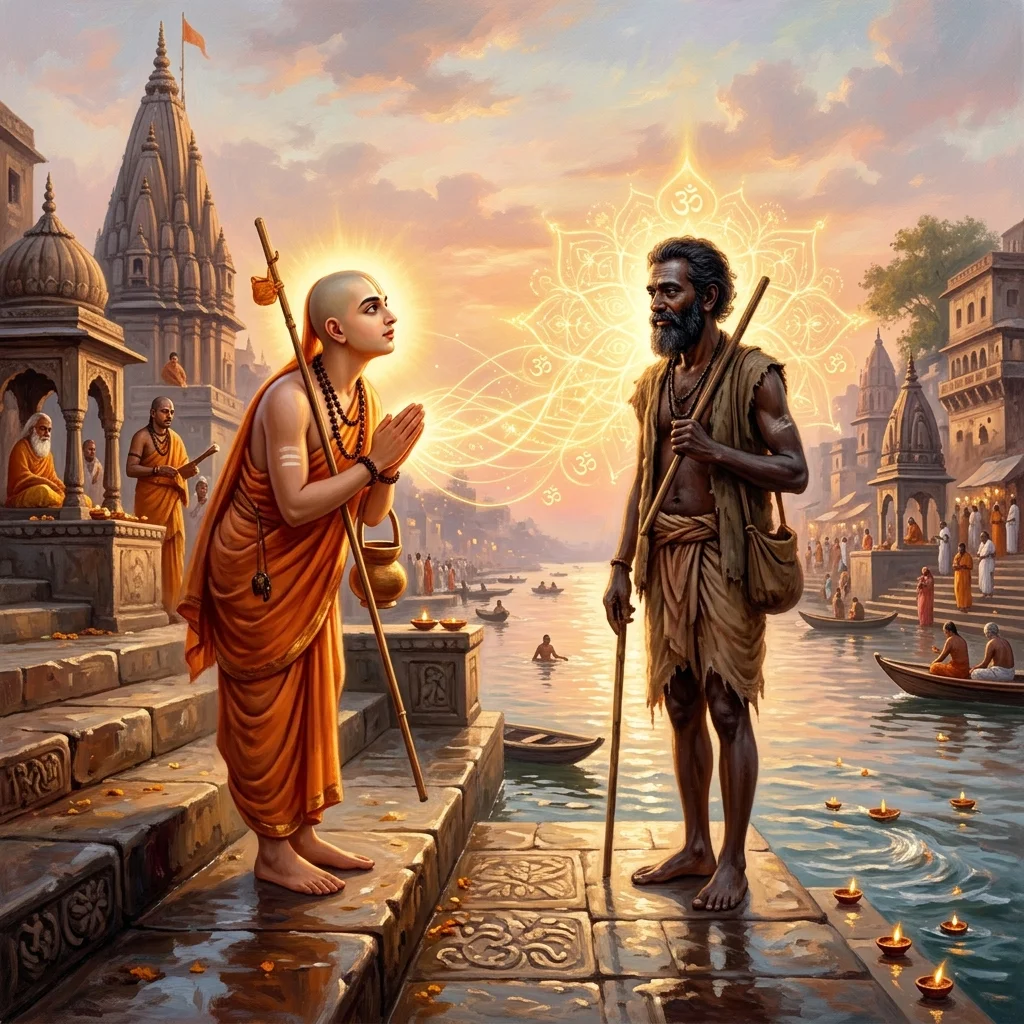
According to tradition, while walking toward the Ganges in Varanasi (Kashi), Shankaracharya encountered a Chandala (a socially marginalized outcaste). When asked to move aside, the Chandala responded with a profound philosophical challenge based on Advaita: "Are you asking my physical body to move, or the consciousness within me? If we share the same Atman, how can one Atman be polluted by another?"
Struck by the realization that this man possessed the ultimate spiritual truth, Adi Shankaracharya bowed to him and composed the Maneesha Panchakam. In its very first verse, Shankaracharya shatters the concept of birth-based supremacy:
Location: Maneesha Panchakam, Verse 1
चाण्डालोऽस्तु स तु द्विजोऽस्तु गुरुरित्येषा मनीषा मम ॥ cāṇdālo'stu sa tu dvijo'stu gururityeṣā manīṣā mama || "Whether he be a Chandala or a twice-born (Brahmin), he who has this realization is my Guru. This is my firm conviction."
This is the ultimate, undeniable proof of Hinduism's core thesis. At the absolute highest level of Hindu realization, physical birth, lineage, and social varna are entirely irrelevant. The greatest philosopher in Hindu history publicly declared that a socially marginalized individual who possesses spiritual wisdom is superior to a scholar who does not.
The Perspective of Modern Reformers
This distinction between core philosophy and corrupted social practice has been highlighted by the most prominent intellectual figures in modern Hindu history.
Swami Vivekananda, who played a pivotal role in introducing Vedanta to the Western world, explicitly separated religion from the social decay of the caste system:
"Caste is simply a crystallized social institution... It is in the nature of society to form itself into groups... but religion has nothing to do with it. The Vedic doctrine is that of the spiritual oneness of all."
Dr. S. Radhakrishnan, the renowned philosopher and former President of India, similarly observed:
"The institution of caste illustrates the spirit of comprehensive synthesis characteristic of the Hindu mind... [But] when birth became the sole basis of caste, the system lost its original flexibility and became a source of social oppression."
Reclaiming the Core Philosophy
When analyzing a tradition as vast and ancient as Hinduism, academic integrity requires looking at its highest, most authoritative texts. The Upanishads and the Bhagavad Gita demand the recognition of spiritual equality and classify human endeavor by character and action, rather than birth.
While the Manusmriti has historical significance as a record of ancient social organization—and its negative impacts on subsequent generations must be acknowledged and critiqued—it does not, and never did, hold the supreme authority to define the Hindu soul.
We are left with a clear choice: We can define Hinduism by its actual supreme texts, which demand the spiritual equality of all beings. Or, we can ignore the rules of Hindu jurisprudence and cling to an outdated, lower-tier social manual simply because it validates a specific political narrative. To truly understand Hinduism, one must look past the temporal laws of men and examine the eternal philosophy of consciousness that forms its true foundation.
📖 Read on VedaSeek
- Explore the Upanishads Collection to read the foundational Shruti texts.
- Explore the Bhagavad Gita with original Sanskrit, translation, and AI commentary.
Discover Wisdom
Explore answers to life's biggest questions from the Vedas.
Recommended
Mental Peace
Your Mind Is Hijacking Your Life—Here’s How to Take It Back
Chapter 6 reveals Krishna’s step-by-step method to calm the restless mind and build unshakable inner peace.
Read Now
Recommended
Mental Health
Overthinking Is a Trap—Try This to Quiet Your Brain Fast
Ancient tools to stop mental spirals, regain focus, and feel calm again—without forcing “positive vibes.”
Read Now
Recommended
Hidden Truths
A Boy Asked Death What Happens After You Die—Death Answered
The holds a jaw-dropping conversation that reshapes fear, life, and what’s beyond.
Read Now