
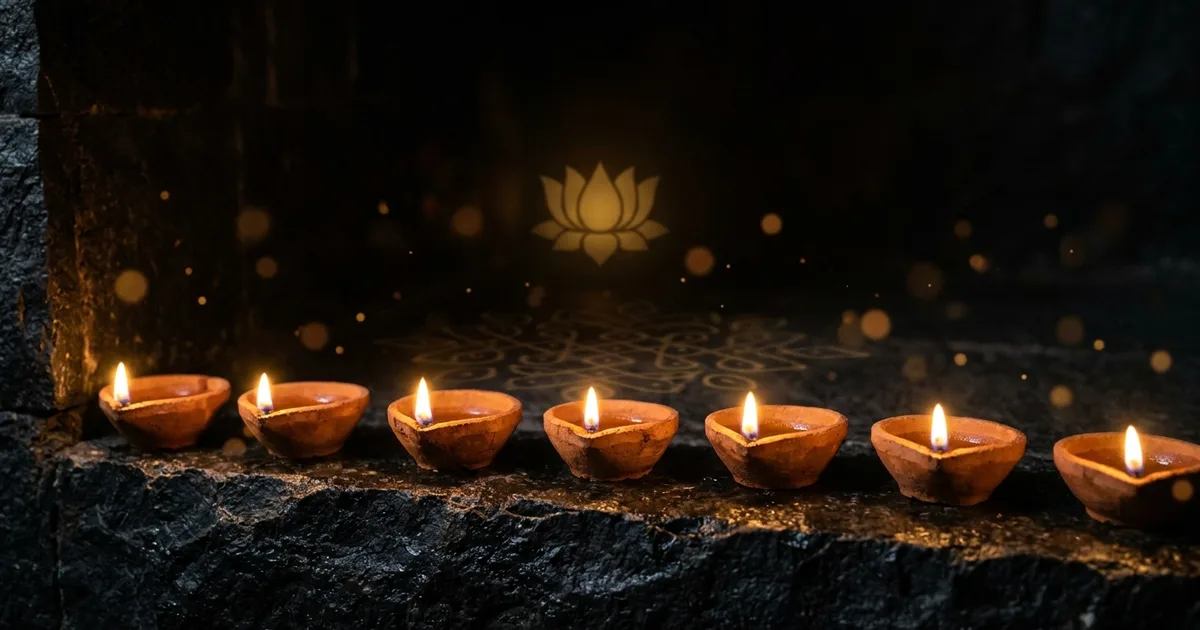
शुभ दीपावली
Happy Diwali from VedaSeek
May the light within you recognise the light in all.
Send this greeting to your family and friends
Diwali reading series
3 Nights of Lakshmi
The Saubhagya Lakshmi Upanishad is a Shakta Upanishad of the Rig Veda. It has exactly three sections, so read one each night of Diwali. It begins with the Sri Suktam, the hymn chanted at Lakshmi Puja, and ends deep in meditation.
- Night 1 · Sun, Nov 8Lakshmi PujaŚrī: The Goddess of AuspiciousnessThe Saubhagya Lakshmi Vidya and the Sri Suktam, the hymn of every Lakshmi Puja.Read Khanda 1
- Night 2 · Mon, Nov 9Govardhan PujaInner Wealth: Yoga and StillnessWhy the Rishis located true prosperity in a disciplined, focused mind.Read Khanda 2
- Night 3 · Tue, Nov 10AnnakutThe Lotus Within: Awakening the ChakrasThe inner journey from the root to the thousand-petalled lotus.Read Khanda 3
Lakshmi is more than money
Saubhāgya means auspiciousness: a life in which things go well. The Upanishad treats Lakshmi as the power behind that kind of fortune. It points the seeker away from craving and towards discipline, stillness and the light of the Self. The diyas we light outside stand for the lamp we light within.
Lakshmi Puja 2026
Sunday, 8 November 2026. In New Delhi the muhurat is 5:54 PM – 7:50 PM IST (Pradosh Kaal 5:31 – 8:09 PM). Timings change with sunset, so check your local panchang.
Diwali 2026: Frequently Asked Questions
When is Diwali Lakshmi Puja in 2026?
Diwali Lakshmi Puja is on Sunday, 8 November 2026. In New Delhi the muhurat is 5:54 PM to 7:50 PM IST (Pradosh Kaal 5:31 PM to 8:09 PM). Outside India, perform the puja after your local sunset on 8 November and check a local panchang for exact timings.
What is the Saubhagya Lakshmi Upanishad?
The Saubhagya Lakshmi Upanishad is a Shakta Upanishad of the Rig Veda and one of the 108 canonical Upanishads. Its three khandas cover worship of Lakshmi through the Sri Suktam, yoga and samadhi, and meditation on the nine chakras. It teaches that real fortune (saubhagya) comes to those who seek Lakshmi without selfish craving.
Which mantras are chanted on Diwali?
A traditional order is: Om Gam Ganapataye Namah to Ganesha first, then Om Lakshmi Narayanaya Namah, then Om Shreem Mahalakshmyai Namah chanted 108 times, then the Sri Suktam (hiranyavarnam harinim...), a Vedic hymn to Lakshmi from the Rig Veda Khila.
What is the spiritual meaning of Diwali?
Diwali celebrates the victory of light over darkness. In the Upanishadic reading, Lakshmi stands for saubhagya, meaning auspiciousness, clarity and inner abundance rather than money alone. The lamps lit outside stand for the light of the Self within.