
Bhagavad Gita
The divine discourse between Lord Krishna and Arjuna on the battlefield of Kurukshetra — the ultimate guide to duty, devotion, and self-realization. Begin your journey through its chapters.
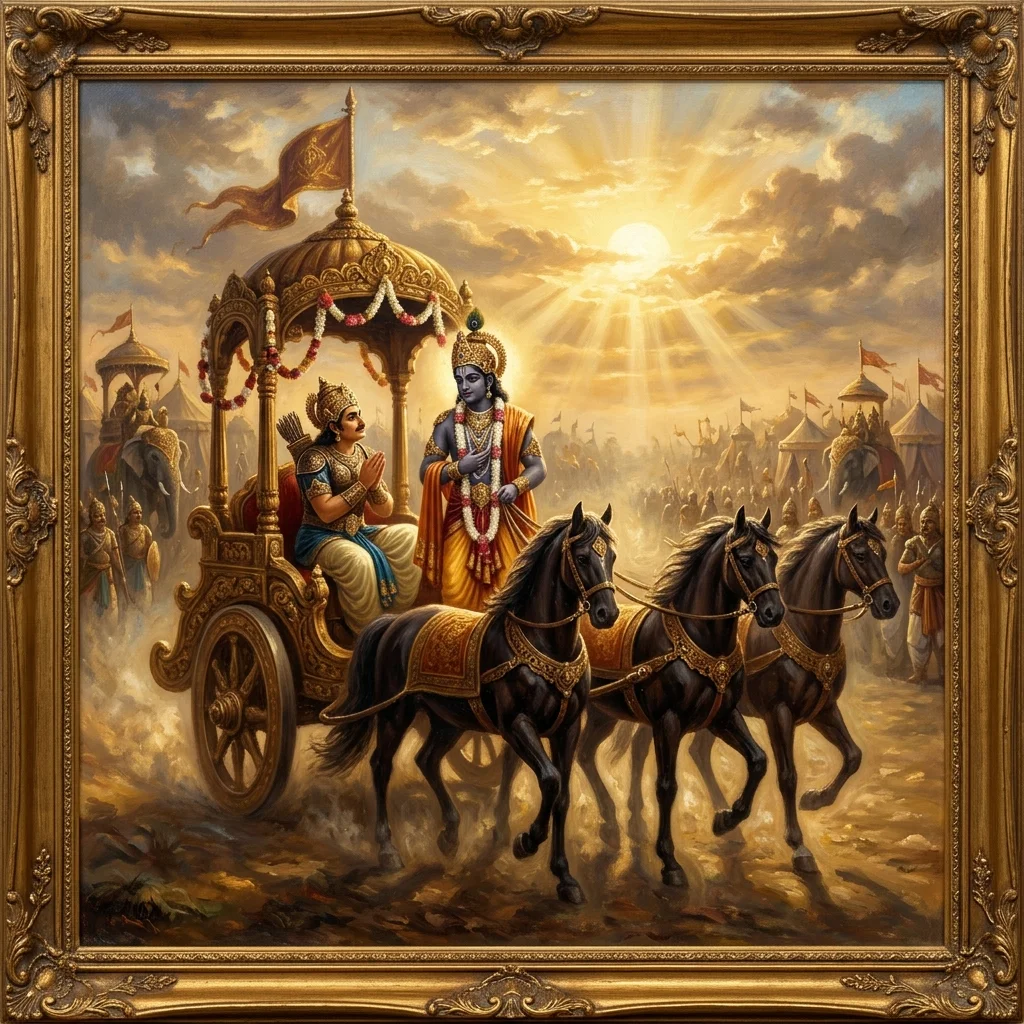
Arjuna's Anguish: The Yoga of Despondency
अर्जुन विषाद योग
This foundational chapter sets the dramatic stage for the Bhagavad Gita, portraying Arjuna's profound moral crisis and deep despondency (viṣāda) on the brink of the Kurukṣetra war. It meticulously details his internal conflict over dharma, duty, and the tragic consequences of kinslaying, thereby establishing the existential dilemma that necessitates Kṛṣṇa's subsequent transcendental discourse on righteous action and spiritual wisdom.
The Yoga of Analytical Knowledge and Steady Wisdom
सांख्य योग
This foundational chapter initiates Arjuna into profound spiritual knowledge, elucidating the distinction between the imperishable Self (ātman) and the perishable body, thereby alleviating his grief. It comprehensively outlines the principles of action without attachment (Karma Yoga) and culminates with the seminal description of a person of steady wisdom (sthitaprajña), establishing the philosophical bedrock for the entire Bhagavad Gita.
Karma Yoga: The Discipline of Action Without Attachment
कर्मयोग
This chapter thoroughly elucidates Karma Yoga, emphasizing that action is both unavoidable and crucial for individual and cosmic order, yet liberation stems from performing actions without attachment to their fruits. It critically examines righteous action (dharma), the concept of sacrifice (yajña), and the necessity of fulfilling one's duty while consciously controlling desires, thereby integrating spiritual discipline with active worldly participation.
The Yoga of Divine Knowledge and Renunciation in Action
ज्ञानकर्मसंन्यासयोग
This chapter elucidates the ancient lineage of spiritual wisdom, detailing the divine purpose of avataras in re-establishing dharma, and presenting the profound synergy between enlightened action and renunciation. It teaches that actions performed with profound spiritual knowledge and detachment effectively transform into acts of renunciation, leading to ultimate liberation.
The Yoga of Actional Renunciation: The Path to Inner Freedom
कर्मसंन्यास योग
This chapter elucidates the profound unity between sannyāsa (renunciation) and karma yoga (action), demonstrating that true freedom is found not in physical abstention from work but in the internal detachment from its fruits. It underscores the spiritual efficacy of performing duties with equanimity and a selfless disposition, revealing that both paths converge on the ultimate goal of liberation through a unified understanding.
The Yoga of Meditation: Cultivating Inner Stillness
ध्यान योग
Chapter 6 meticulously delineates the practical methodology of Dhyāna Yoga, offering detailed instructions on posture, breath control, and mental discipline essential for quieting the restless mind. It illuminates the path to self-realization through sustained meditative practice, leading to profound inner peace and the experience of the unified Self.
The Yoga of Knowledge and Realization of the Absolute Truth
ज्ञानविज्ञानयोग
This chapter delineates the dual nature of the Supreme Being, Bhagavān Kṛṣṇa, articulating both His material (aparā prakṛti) and spiritual (parā prakṛti) energies. It unveils the path to comprehensive knowledge of the Absolute Truth, emphasizing that profound realization of the divine is achieved through exclusive and unwavering devotion, thereby integrating epistemology with spiritual practice.
The Yoga of the Imperishable Brahman and Ultimate Liberation
अक्षरब्रह्मयोग
This chapter profoundly explores the nature of the Imperishable Brahman, the Supreme Being, and the significance of one's consciousness at the time of death for attaining ultimate liberation. It elucidates the concepts of adhyatma (the Self), karma, adhibhuta (material manifestation), adhidaiva (divine beings), and adhiyajna (Lord of sacrifice), guiding the seeker towards unwavering remembrance of the Divine for release from the cycle of rebirth.
The Yoga of the Sovereign Science and Supreme Mystery
राजविद्या राजगुह्य योग
This chapter unveils the sovereign science and profound secret of the divine, elucidating Krishna's pervasive yet unattached presence in the cosmos and His ultimate nature as the Supreme Being. It underscores that through pure devotion (Bhakti Yoga), all beings, regardless of their social standing, can easily attain the Supreme, emphasizing the transformative power of sincere surrender.
The Yoga of Divine Opulences: Krishna's Universal Expansions
विभूति योग
This chapter profoundly reveals Lord Krishna as the supreme source of all existence, detailing His countless divine opulences (vibhūtis) manifest across the cosmos. It guides the devotee to perceive all glories, strengths, and beauties as emanations of His boundless splendor, fostering deep devotion and a comprehensive understanding of His omnipresent nature.
The Vision of the Cosmic Form: Arjuna's Divine Revelation
विश्वरूप दर्शन योग
This pivotal chapter describes Arjuna's request to witness Krishna's true divine form and the subsequent awe-inspiring vision of the Viśvarūpa, the Universal Form, which encompasses all creation, past, present, and future. It profoundly demonstrates the immanence and transcendence of the Divine and underscores the unparalleled power and majesty of the Supreme Being, cementing devotion and understanding of God's omnipresence.
The Yoga of Pure Devotion: Cultivating Unwavering Love
भक्तियोग
Chapter 12 delves into Bhakti Yoga, elucidating the distinction between saguna (personal) and nirguna (impersonal) worship of the Divine. It emphasizes the practical superiority of saguna bhakti for most aspirants, detailing the sublime qualities and unwavering commitment that define a devotee truly beloved by Krishna.
The Yoga of Discrimination: Discerning the Field and its Knower
क्षेत्रक्षेत्रज्ञविभागयोग
This profound chapter elucidates the critical distinction between kṣetra (the perishable body-mind complex, the field of experience) and kṣetrajña (the immortal self or consciousness, the knower of the field). It defines true knowledge as the realization of this fundamental duality and the ultimate oneness of the kṣetrajña with Brahman, thereby guiding seekers towards liberation through discriminative wisdom and the understanding of Prakriti and Purusha.
The Yoga of the Three Gunas: Transcending Material Qualities
गुणत्रयविभागयोगः
This chapter elucidates the nature and binding effects of the three Gunas—Sattva, Rajas, and Tamas—which constitute Prakriti and influence all embodied beings. It meticulously describes the characteristics of a Guṇātīta, one who transcends these material qualities, thereby attaining liberation and realizing their essential spiritual nature.
The Yoga of the Supreme Puruṣottama: Understanding the Ultimate Reality
पुरुषोत्तम योग
This chapter profoundly describes the cosmos as an inverted Aśvattha tree, symbolizing the ephemeral material world, and posits the Supreme Being (Puruṣottama) as transcending both perishable and imperishable existence. It illuminates Krishna's ultimate reality as the omnipresent, omniscient Lord, advocating devotion and detachment as the path to sever material entanglement and achieve liberation.
The Yoga of Divine and Demoniac Qualities: A Discriminative Study
दैवासुरसम्पद्विभाग योग
This chapter vividly describes the divine and demoniac natures, outlining the virtues that lead to liberation and the vices that bind one to the cycle of suffering. It provides a crucial ethical framework, guiding aspirants to cultivate auspicious qualities for spiritual progress and avoid detrimental dispositions.
The Yoga of Threefold Faith: Discernment of Spiritual Practices
श्रद्धात्रयविभागयोग
This chapter profoundly analyzes the three fundamental types of faith (śraddhā) corresponding to the guṇas, revealing how these innate qualities intrinsically shape an individual's spiritual disciplines, diet, acts of worship, penance, and altruism. It offers critical discernment for practitioners to evaluate the purity and efficacy of their actions, fostering an understanding of true spiritual integrity.
The Yoga of Final Liberation Through Renunciation and Surrender
मोक्षसंन्यासयोग
This concluding chapter comprehensively recapitulates the entire Bhagavad Gita, meticulously distinguishing between sannyāsa (complete renunciation) and tyāga (renunciation of the fruits of action) while integrating the paths of Karma, Jnana, and Bhakti Yoga. It culminates in the profound teaching of absolute surrender (śaraṇāgati) to the Supreme Lord, revealing it as the direct and ultimate path to liberation (Moksha) and the highest good.