
Suryasiddhanta
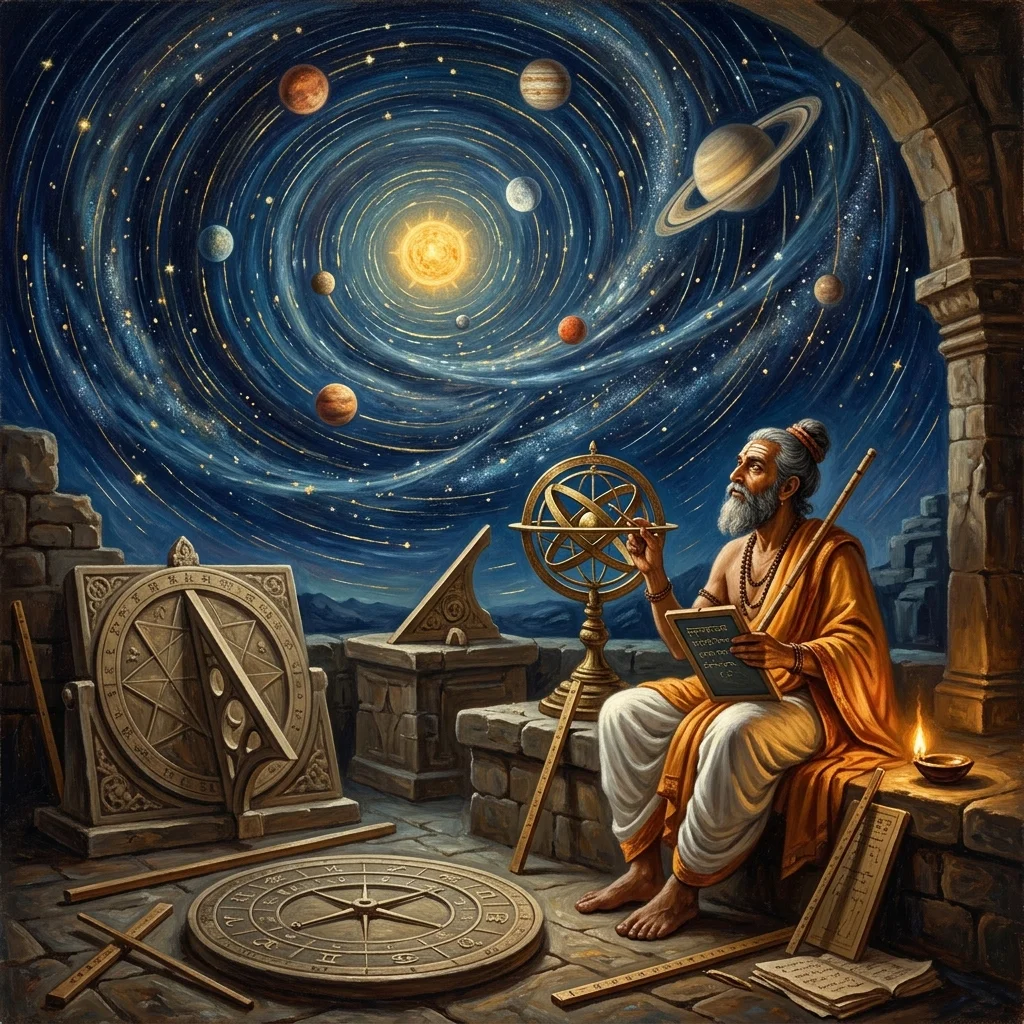
One of the most important classical Sanskrit texts on Indian astronomy — covering planetary positions, eclipses, and the Vedic system of time. Begin your journey through its chapters.
The Calculation of Mean Planetary Motions
मधमाधिकार
This foundational chapter introduces the cosmic units of time, such as kalpas, yugas, and days, and establishes the parameters for calculating the mean positions and velocities of planets. It lays the groundwork for understanding the structure of Hindu astronomical calculations, defining epochs and the fundamental constants of celestial motion.
The Determination of True Planetary Positions
स्पष्टाधिकार
This chapter meticulously delineates the methods for calculating the true longitudes of planets, moving beyond their mean motions by incorporating various astronomical corrections and anomalies. It is fundamental for precise astronomical observations, calendrical computations, and astrological predictions within the Siddhantic tradition, detailing adjustments for planetary eccentricity and epicycles.
The Three Problems of Direction and Time
त्रिप्रश्नाधिकार
This chapter meticulously details the methods for solving the 'three problems' (triprashna), which are fundamental astronomical calculations related to determining time, place, and direction on Earth. It provides rigorous procedures for computing the sun's declination, the length and direction of the gnomon's shadow, and deriving local time from celestial altitudes, essential for accurate observational astronomy.
The Lunar Computations and Phases
चंद्राधिकार
This chapter meticulously details the mathematical models and algorithms for determining the Moon's true position, its varying velocity, and its phases. It elucidates the methods for calculating lunar parallax and the intricacies of its apparent motion, which are fundamental for calendrical and astrological applications.
The Principles and Calculation of Eclipses
ग्रहणसंस्काराधिकारः
This chapter meticulously details the astronomical principles and computational methods required for predicting solar and lunar eclipses, including various corrections and parameters necessary for accurate timing and visibility. It delves into the precise geometry of shadow cones and the critical alignment of celestial bodies, foundational for both calendrical and ritualistic applications.
The Rising and Setting of Planets
उदायास्ताधिकारः
This chapter delineates the precise astronomical methods for calculating the heliacal rising and setting of various planets, establishing their periods of visibility and invisibility in the sky. It provides critical insights into the observation and prediction of celestial phenomena essential for calendrical systems and early astrological practices.
The Conjunctions of Planets and Stars
ग्रहयुत्यधिकारः
This chapter meticulously details the intricate methods for calculating the conjunctions of various planets with each other and with specific nakshatras (lunar mansions) and other fixed stars. It elucidates the precise astronomical principles and mathematical procedures required to determine these celestial alignments, which are crucial for both calendrical accuracy and astrological prognostication.
Terrestrial Geography and Cosmic Structure
भूगोल-अध्याय
This chapter meticulously describes the Earth's dimensions, its spherical nature, and its various geographical divisions including continents (dvipas) and oceans, forming the fundamental geocentric model of the universe. It elucidates ancient Indian concepts of terrestrial space, setting the stage for advanced astronomical calculations based on geographical location.
The Illumination and Visibility of Lunar Cusps
शृङ्गोन्नतिः
This chapter meticulously details the astronomical methods for calculating the precise illumination and apparent visibility of the Moon's horns or cusps. It delves into the geometric principles and computational techniques required to understand this intricate lunar phenomenon, reflecting the text's advanced mathematical and observational prowess.
The Projection of Eclipses and Celestial Diagrams
छेद्यकोत्तरम्
This chapter delves into the advanced methods of projecting celestial phenomena, particularly eclipses, onto a plane surface using principles of spherical geometry. It describes the construction of diagrams and the use of the gnomon to visually represent complex astronomical calculations, providing essential tools for ancient Indian astronomers to understand and predict celestial events.
The Elevation of the Lunar Crescent
शृङ्गोन्नति ज्ञानम्
This chapter meticulously details the methods for calculating the elevation of the moon's horns (crescent), addressing the geometric principles and observational complexities involved in determining the apparent shape and orientation of the lunar crescent. It serves as a crucial guide for astronomical prediction and visual representation of the Moon's phases, integral to the Sidereal tradition of Hindu astronomy.
Description of the Earth and its Terrestrial Sphere
भूगोलकम्
This chapter systematically describes the Earth's spherical nature, its dimensions, and geographical features as understood in ancient Indian astronomy. It elaborates on concepts such as the equator, poles, and significant geographical points, laying the foundation for terrestrial measurements within the astronomical framework.
The Principles of Astronomical Measurement
मान-अध्याय
This chapter meticulously details the fundamental principles and various instruments utilized for precise astronomical measurement, elucidating the methodologies for observing celestial phenomena and accurately calculating spatial and temporal units. It offers critical insights into the practical application of theoretical astronomical knowledge, which is indispensable for constructing ancient calendars and predicting celestial events.
The Treatise on Measures and Astronomical Instruments
मानाध्यायः
This concluding chapter elucidates the fundamental units of time and linear measure essential for astronomical computations, alongside descriptions of various instruments used for celestial observation. It provides crucial context for interpreting the numerical values and computational methods presented throughout the text, emphasizing practical application in ancient Indian astronomy.